
The Supreme Court Takes the Case: Stress-Testing New Jersey's Stressor Test
The news
In January 2026, a state appeals court upheld NJDEP’s Environmental Justice rules in full (my post on the appeals court ruling). On July 14, 2026, the New Jersey Supreme Court agreed to hear an appeal (K&L Gates, 2026). The challengers are the New Jersey chapter of the Institute of Scrap Recycling Industries and a labor-management group affiliated with Operating Engineers Local 825, supported by the New Jersey Business & Industry Association and the Chemistry Council of New Jersey (Riker Danzig, 2026). According to a summary of the petition, the issues include (Riker Danzig, 2026):
- whether the rules can apply to facilities in unpopulated block groups that border overburdened communities;
- whether existing facilities that lack required approvals can be treated as “new”;
- whether the “Localized Impact Control Technology” standard is too vague; and
- whether NJDEP needed formal rulemaking before issuing its mapping tool and technical guidance.
Briefs were due by the end of September, and the rules remain in effect while the case is pending.
The last issue is about the data and math behind the map, the subject of many of my earlier posts. In my post on the appeals court ruling, I showed that NJDEP’s published determinations can be reproduced exactly from its published data. That shows the method is transparent. A different question is whether the results are robust: how much do they depend on any single data layer, or on small errors in the data?
Quick refresher: the stressor test
For each of 26 environmental and public health stressors, NJDEP compares a block group’s value with a “geographic point of comparison,” the lower of the statewide or county median among non-overburdened block groups. Each stressor above that point counts toward the Combined Stressor Total (CST). An overburdened community (OBC) faces “adverse cumulative stressors” if its CST is higher than the comparison value computed the same way. That determination affects how strictly new or expanding facilities are reviewed.
Using the March 2026 data version, my code again matched NJDEP’s determinations for 100% of populated OBCs: 3,156 of 3,682 (85.7%) are classified as facing adverse cumulative stressors.
Test 1: what if one stressor were removed?
Suppose a court or NJDEP threw out one data layer. How many communities would change status? I dropped each stressor in turn and reran the whole rule.
| Stressor dropped | OBCs that would lose “adverse” status | OBCs that would gain it | Total changes |
|---|---|---|---|
| Emergency planning sites | 138 | 19 | 157 |
| Lack of tree canopy | 120 | 26 | 146 |
| Lack of recreational open space | 117 | 24 | 141 |
| Impervious surface | 117 | 23 | 140 |
| Education | 111 | 18 | 129 |
| Age of housing | 96 | 32 | 128 |
| Traffic (cars, light trucks) | 106 | 17 | 123 |
| Air toxics cancer risk | 96 | 25 | 121 |
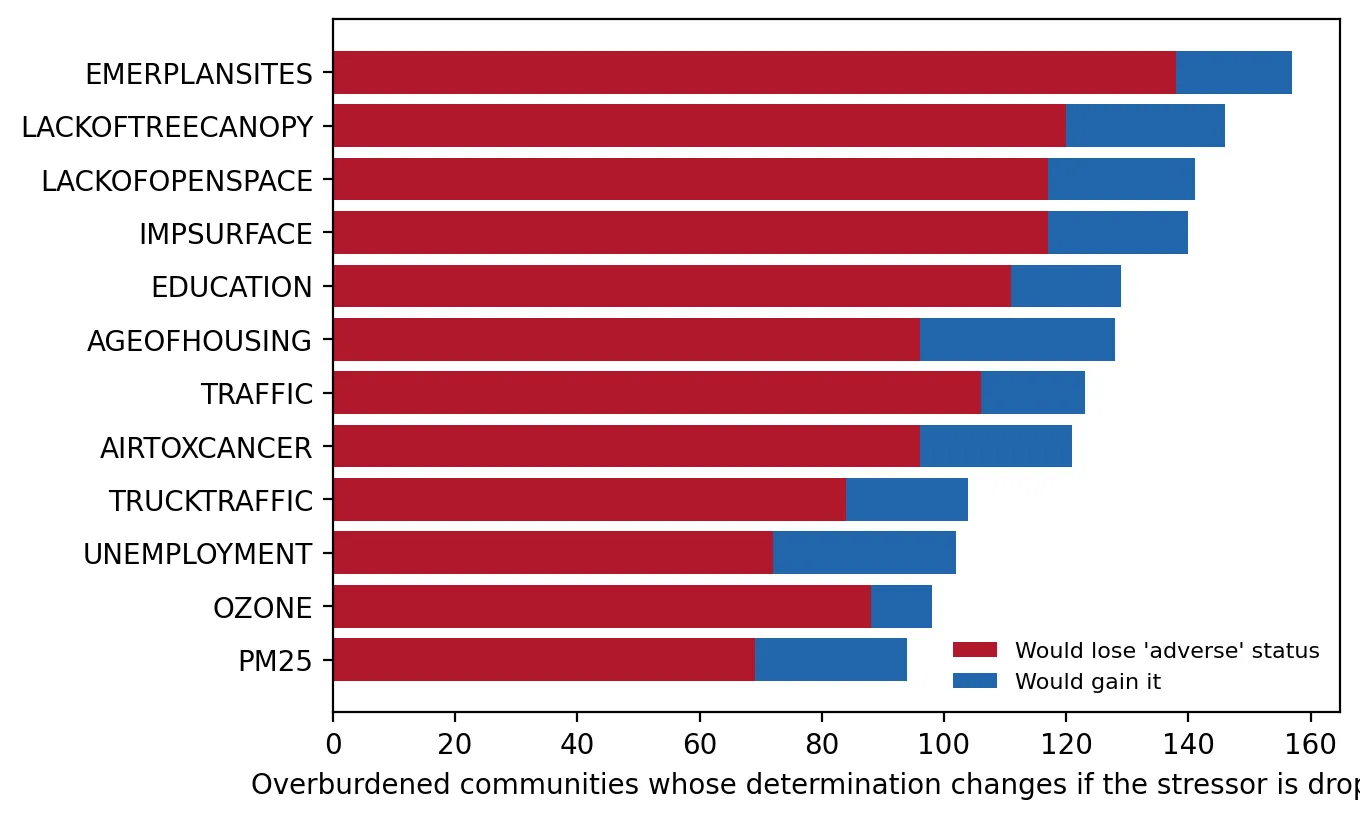 Figure 2. Dropping any single stressor changes the status of at most 157 overburdened communities.
Removing any single stressor changes the status of a median of 84 OBCs, about 2% of them, and at most 157 (4%). No single layer controls the outcome. Interestingly, some communities would gain “adverse” status when a stressor is removed, because dropping a layer also lowers the comparison value.
Test 2: what if the data have small errors?
Every data layer has measurement error. Air models, satellite land cover, and survey estimates are not exact. I ran a Monte Carlo simulation: I multiplied every stressor value by a small random error (typically ±10%), recomputed all the medians and the full rule, and repeated this 500 times.
- 2,898 OBCs were “adverse” in at least 95% of runs, a stable yes.
- 352 OBCs were “adverse” in at most 5% of runs, a stable no.
- 432 OBCs (11.7%), home to about 635,000 people, were in between: their status is fragile.
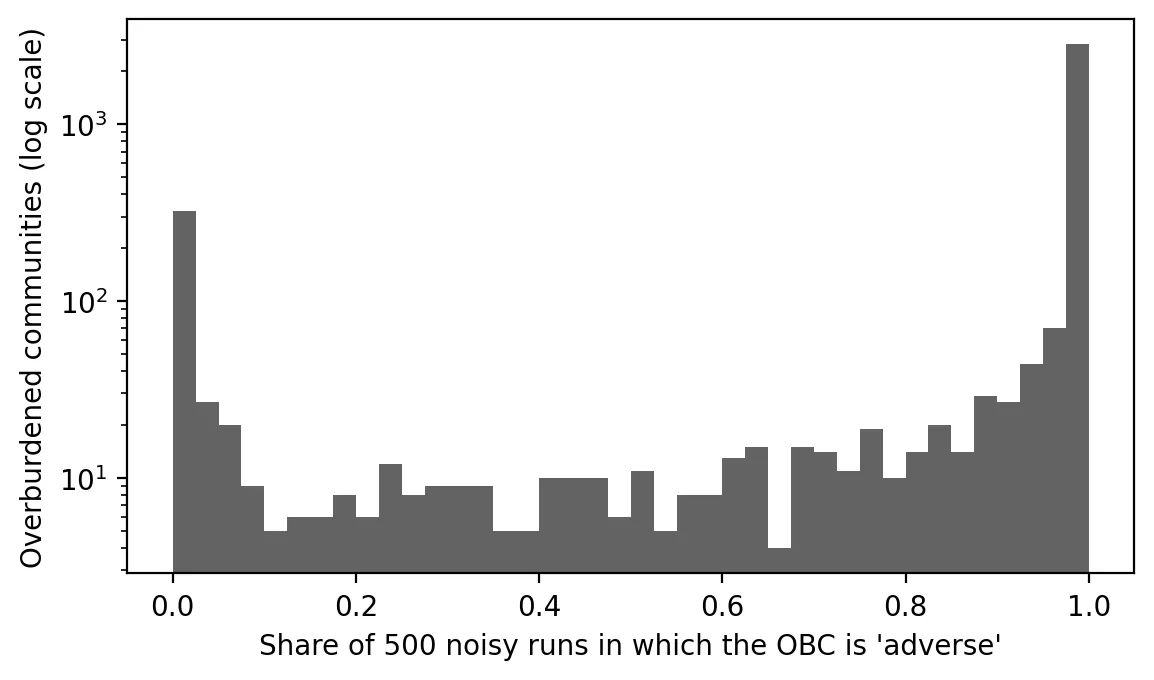 Figure 1. Most communities are stably adverse or not adverse under small data errors, but a few hundred are fragile.
Fragility is concentrated where you would expect: communities whose CST is within one point of the comparison value. Among OBCs whose CST exactly equals the comparison value, 84% were fragile. Communities two or more points away were almost never affected.
What this means
These tests point in two directions at once:
- The method is robust overall. For almost 9 in 10 OBCs, the determination holds up whether a layer is removed or the data are jiggled. That’s a reasonable sign for a regulatory tool.
- Bright lines create edge cases. Any rule that turns a continuous measure into a yes/no answer will have communities right at the line. For about one in nine OBCs, the result depends on details as small as measurement error.
Neither result says how the court should rule; the legal questions are about NJDEP’s authority and procedure, not statistics. But an uncertainty analysis like this could help in practice. For example, NJDEP could publish a “confidence” indicator alongside each determination, or review borderline cases with closer local data, as other agencies do with environmental screening tools.
Limitations
- My error model is simple. I applied the same ±10% error to every stressor. Real errors differ by layer, and some are larger.
- Zero values stay zero. Multiplying by noise doesn’t create a facility where none exists, so count-type stressors are less affected than they would be by location errors.
- Two yes/no stressors (combined sewer overflows and drinking water) were held fixed.
- Adjacent block groups. The 52 zero-population block groups that border OBCs, one of the issues before the court, use a neighboring OBC’s CST and were excluded from my counts.
Code project (Level 6): robustness and uncertainty
Goal: Test how sensitive NJDEP’s “adverse cumulative stressors” determinations are to individual stressors and to measurement error.
Data: NJDEP EJ Law Combined Stressor Summary (version effective Mar 31, 2026).
Method:
- Write the full rule as one function (
determine), so it can be rerun with altered inputs. - Confirm it reproduces NJDEP’s published determinations.
- Leave-one-out: rerun without each stressor and count status changes.
- Monte Carlo: multiply every value by lognormal noise, rerun 500 times, and record each community’s share of “adverse” outcomes.
- Relate fragility to how close each community’s CST is to its comparison value.
hits = np.zeros(len(g))
for i in range(500):
    noisy = vals * np.exp(rng.normal(0, 0.10, vals.shape))   # ~±10% error on every stressor
    hits += determine(noisy, g, pool, fixed).values
p_adverse = hits / 500                                        # 0 = never adverse, 1 = always
New skills: turning a procedure into a reusable function, sensitivity analysis, and simulation-based uncertainty.
Data and methods
Data sources
- NJDEP EJ Law Combined Stressor Summary (version effective Mar 31, 2026).
The analysis was done in Python with public data. The full code, its data, and every figure it produces are in the code project below.
References
- K&L Gates. (2026, August 31). Environmental justice—update. National Law Review. https://natlawreview.com/article/environmental-justice-update-0
- New Jersey Department of Environmental Protection. (2026). Environmental Justice (EJ) Law Combined Stressor Summary (Current) [Data set]. https://www.arcgis.com/home/item.html?id=8f1eeb5074d147af8ab3e5e5a4f72d2b
- New Jersey Superior Court, Appellate Division. (2026, January 5). In the Matter of the New Jersey Department of Environmental Protection's Adoption of N.J.A.C. 7:1C (A-2936-22/A-2959-22). https://www.njcourts.gov/system/files/court-opinions/2026/a2936-22a2959-22.pdf
- Riker Danzig. (2026, September 3). New Jersey Supreme Court to review NJDEP's environmental justice rules. https://riker.com/blog/environmental-law/new-jersey-supreme-court-to-review-njdeps-environmental-justice-rules/