
The Ironbound's Fourth Power Plant: A Court Hits Pause
The news
On October 27, 2025, the Essex County Superior Court stayed construction of a gas-fired power plant that the Passaic Valley Sewerage Commission (PVSC) plans to build at its wastewater treatment plant in Newark’s Ironbound neighborhood. The stay keeps the project on hold while the court considers a lawsuit by the Ironbound Community Corporation (ICC) and the City of Newark (Earthjustice, 2025b).
The project dates back to Hurricane Sandy in 2012, when PVSC’s plant lost grid power for about two days. PVSC proposed an on-site “standby” power plant made up of three gas turbines with a combined 84 megawatts. According to ICC’s lawsuit, NJDEP issued the plant’s air permit in April 2025 after an environmental justice review under an interim administrative order, and PVSC’s board approved the construction contract on June 12, 2025 (ICC v. PVSC, 2025; Earthjustice, 2025a). Residents and city officials argue that the Ironbound, already home to three gas-fired power plants and the state’s largest garbage incinerator, should not get a fourth plant, especially when battery storage could provide backup power.
The question
How burdened is the area around PVSC, and how does that burden change with distance from the plant?
Method: distance rings
I drew rings at 1, 2, 3, 5, and 10 miles around PVSC’s treatment plant and summarized NJDEP’s environmental justice data (the version in effect in November 2025) for the block groups in each ring. A distance-ring analysis is a simple way to ask whether conditions are worse closer to a facility.
Findings
Burden is high, and it doesn’t fade with distance
| Distance from PVSC | Residents | Share in an OBC | Combined Stressor Total (pop.-weighted) | Diesel PM indicator (NJDEP)* |
|---|---|---|---|---|
| 0–1 mi | 3,114 | 100% | 19.0 | 0.26 |
| 1–2 mi | 60,361 | 100% | 19.7 | 0.51 |
| 2–3 mi | 152,428 | 98% | 18.5 | 0.47 |
| 3–5 mi | 519,787 | 98% | 18.0 | 0.51 |
| 5–10 mi | 1,222,295 | 83% | 17.4 | 0.46 |
| New Jersey | 15.0 | 0.28 |
The Combined Stressor Total counts how many of 26 environmental and social stressors are above NJDEP’s comparison values. *NJDEP labels its diesel field “cancer risk per million,” but its values resemble annual diesel particulate concentrations (µg/m³) from EPA modeling; I treat it as a relative indicator.
I expected a steep “distance decay,” with the worst conditions right next to the plant. Instead, the burden stays high across the whole region. Almost everyone within 5 miles of PVSC, about 735,000 people, lives in an overburdened community, and their stressor totals are 3 to 5 points above the state average. Diesel particulate exposure is nearly double the statewide level throughout.
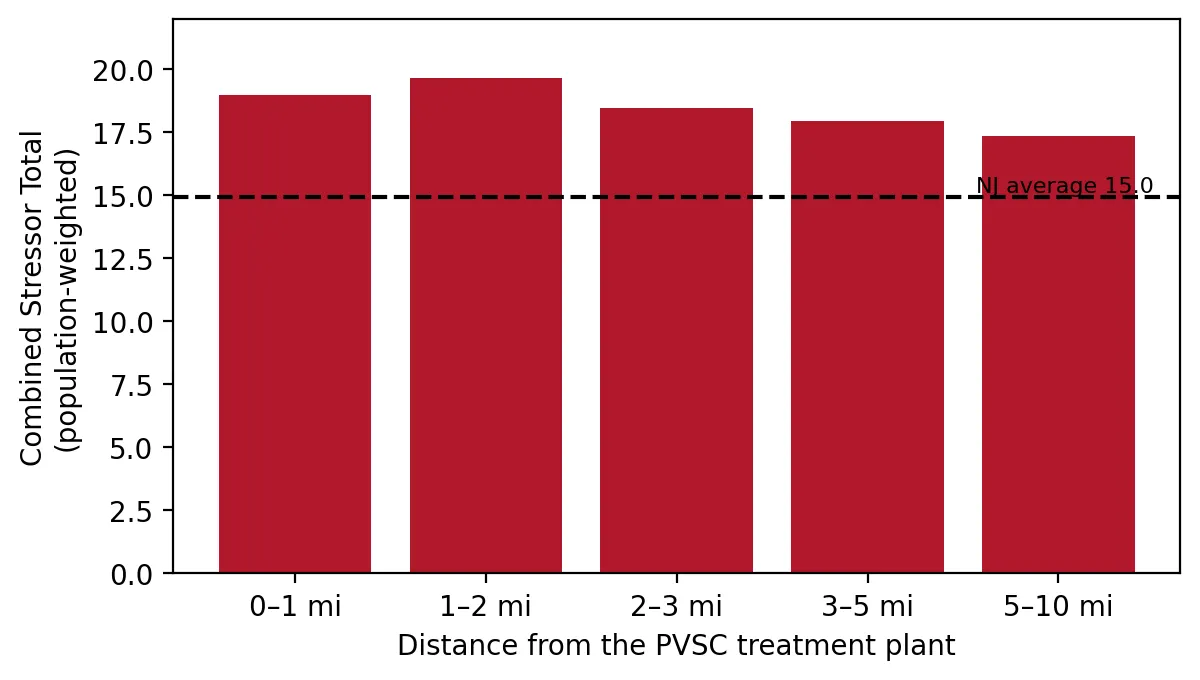 Figure 1. Combined environmental stressor totals stay above the state average at every distance from the PVSC plant.
The flat pattern makes sense. The Ironbound sits inside a much larger industrial region (Newark, Elizabeth, Kearny, Jersey City, Bayonne, Port Newark, Newark Airport, and the New Jersey Turnpike) where pollution sources overlap. No single facility creates the burden; it is cumulative. That is exactly the situation New Jersey’s Environmental Justice Law was written to address.
The power plants already nearby
Within 3 miles of PVSC, NJDEP’s data list five existing generating facilities totaling 1,428 MW:
| Facility | Fuel | Capacity | Distance from PVSC |
|---|---|---|---|
| Newark Energy Center | Natural gas | 708 MW | 0.6 mi |
| Newark Bay Cogeneration | Natural gas | 120 MW | 0.6 mi |
| Covanta Essex (resource recovery) | Waste (listed as biomass) | 60 MW | 1.8 mi |
| PSEG Essex Generating Station | Natural gas | 81 MW | 1.8 mi |
| PSEG Kearny Generating Station | Natural gas | 459 MW | 2.6 mi |
PVSC’s 84 MW plant would be small compared with the Newark Energy Center, and as a backup plant it would run far less often. Supporters see it as a modest, necessary safety measure for a sewage plant that serves well over a million people. Opponents argue that in a place this burdened, any new combustion source is too much when a cleaner alternative exists.
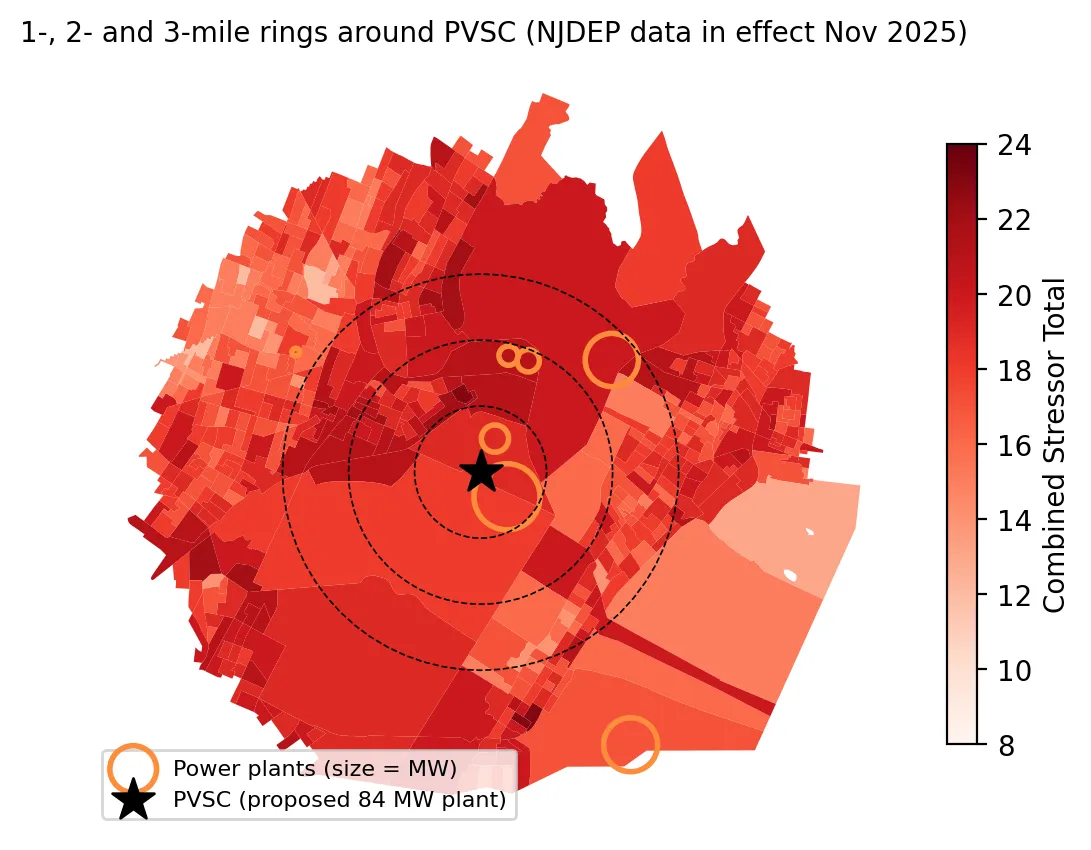 Figure 2. Block groups within 3 miles of the proposed PVSC plant are almost uniformly high in combined stressors, with several existing power plants nearby.
The block group closest to the plant
The single residential block group within a mile of PVSC (about 3,100 residents) is adverse on 19 of 26 stressors, including diesel exhaust, truck and car traffic, railways, contaminated sites, scrap metal facilities, solid waste facilities, flooding, and lack of tree canopy and open space.
What to watch
The court’s stay means the case will turn on whether PVSC’s approval was lawful and whether its justification, including its requirement for two weeks of backup power, holds up. It is also an early test of how New Jersey’s environmental justice framework treats a public agency’s project meant to protect public health.
Limitations
- Rings around one point ignore wind direction and the exact location of each pollution source.
- Block group centroids. Each block group is assigned to a ring by its center point. Only one residential block group falls within a mile.
- Capacity is not emissions. Megawatts measure the size of a plant, not how much it runs or emits.
Code project (Level 3): distance rings
Goal: Summarize cumulative burden in rings around PVSC.
Data: NJDEP EJ Law stressor data (version effective Jan 31, 2025 – Mar 30, 2026); NJDEP major air source and power plant layers.
Method:
- Locate PVSC in NJDEP’s major air source layer.
- Measure the distance (in miles, using the New Jersey State Plane projection) from PVSC to each block group’s representative point.
- Bin distances into rings with
pd.cut, then calculate population-weighted averages in each ring. - List power plants within 3 miles.
bg["miles"] = bg.representative_point().distance(pvsc) / 5280
bg["ring"] = pd.cut(bg.miles, [0, 1, 2, 3, 5, 10], right=False)
ring = bg.groupby("ring").apply(lambda d: np.average(d.CST_BG, weights=d.TOTALPOP))
New skill: distance-based exposure analysis, and recognizing when a “no gradient” result is itself the finding.
Data and methods
Data sources
- NJDEP EJ Law stressor data (version effective Jan 31, 2025 – Mar 30, 2026); NJDEP major air source and power plant layers.
The analysis was done in Python with public data. The full code, its data, and every figure it produces are in the code project below.
References
- Earthjustice. (2025a, June 13). Defying logic, New Jersey green lights yet another gas power plant in Newark [Press release]. https://earthjustice.org/press/2025/defying-logic-new-jersey-green-lights-yet-another-gas-power-plant-in-newark
- Earthjustice. (2025b, October 27). NJ court prohibits construction of controversial Newark gas plant [Press release]. https://earthjustice.org/press/2025/nj-court-prohibits-construction-of-controversial-newark-gas-plant
- Ironbound Community Corporation v. Passaic Valley Sewerage Commission, No. ESX-L-005271-25 (N.J. Super. Ct. Law Div., complaint filed July 14, 2025). https://earthjustice.org/wp-content/uploads/2025/07/2025-07-14-icc-complaint-in-lieu-of-prerogative-writs.pdf
- New Jersey Department of Environmental Protection. (2025). Environmental Justice (EJ) Law Combined Stressor Summary (version effective Jan 31, 2025 – Mar 30, 2026) [Data set]. https://www.arcgis.com/home/item.html?id=8a9ae7bae7a0458fb0f8d3759b145257
- New Jersey Department of Environmental Protection. (n.d.). Power plants (NJ) [Data set]. https://mapsdep.nj.gov/arcgis/rest/services/Features/Utilities/MapServer/20