
Denial by Default? New Jersey's Environmental Justice Law Goes to the State Supreme Court
Abstract. In 2020, New Jersey passed the first law in the nation that lets regulators deny a permit to a new polluting facility because of the pollution that a community already bears. In January 2026, the Appellate Division upheld the rules that put the law into practice, and in July the New Jersey Supreme Court agreed to review them. This post explains how the law works, what the courts have decided, and what is still at stake. I also rebuilt the law’s central test, the “adverse cumulative stressors” determination, from the New Jersey Department of Environmental Protection’s (NJDEP) public data. My version reproduces NJDEP’s results for 100% of the state’s 6,603 census block groups. Under the current rules, 3,167 of New Jersey’s 3,699 overburdened communities (85.6%), home to about 4.6 million people, meet the threshold that triggers the law’s strictest protections. A counterfactual test shows that NJDEP’s choice of comparison area matters: a county-only comparison, closer to what industry challengers argued for, would remove that status from 518 communities, concentrated in Hudson, Bergen, and Essex counties. Finally, I examine the two facilities holding public hearings under the law this month, in Paterson and Linden.
1. Why a “cumulative impacts” law?
For most of the history of American environmental regulation, permits have been judged one facility at a time. A regulator asks whether a single smokestack meets its emission limits, not whether the neighborhood around it already hosts a highway, a scrap yard, a sewage plant, and a dozen contaminated sites. Environmental justice scholars have argued for decades that this approach systematically fails low-income communities and communities of color. Each new facility can be legal on its own while the combined burden on a neighborhood keeps rising (Solomon et al., 2016).
The evidence for unequal exposure is extensive. The United Church of Christ’s 1987 report Toxic Wastes and Race in the United States found that race was the strongest predictor of where commercial hazardous waste facilities were located, and a 20-year follow-up found that the pattern persisted (Bullard et al., 2007). Longitudinal research suggests that unequal siting is not only a result of poorer people later moving near pollution. Facilities have often been placed in neighborhoods that were already disproportionately poor and nonwhite at the time of siting (Mohai & Saha, 2015). More recent modeling of fine particulate matter (PM2.5) found that people of color in the U.S. experience disproportionately high exposure from most major categories of emission sources, not just a few industries (Tessum et al., 2021).
New Jersey learned this lesson in court. In 2001, residents of Camden’s Waterfront South neighborhood sued NJDEP over an air permit for a St. Lawrence Cement grinding facility. Their neighborhood already contained a sewage treatment plant, a trash-to-steam incinerator, and numerous contaminated sites. A federal district judge found that NJDEP had violated federal civil rights regulations by refusing to consider the facility’s cumulative health impacts on an already burdened community (South Camden Citizens in Action v. NJDEP, 2001a). The victory did not last. After the U.S. Supreme Court’s decision in Alexander v. Sandoval (2001), the Third Circuit held that residents could not use federal civil rights law to enforce those regulations, and it reversed (South Camden Citizens in Action v. NJDEP, 2001b). The legal gap was clear: no law required New Jersey regulators to consider cumulative burdens.
Community advocates spent the next two decades trying to fill that gap. A 2009 report by NJDEP’s own Environmental Justice Advisory Council called on the state to build cumulative impacts into its permitting (NJDEP EJAC, 2009). A coalition led by groups including the Ironbound Community Corporation and the New Jersey Environmental Justice Alliance pushed the legislation that became S232 (Sheats et al., 2025). It was signed into law in September 2020 as N.J.S.A. 13:1D-157 to -161.
2. How the law works
The Environmental Justice Law (EJ Law) does not replace New Jersey’s existing environmental permits. It adds a layer on top of them, which the Appellate Division described as an “overlay” (In re NJDEP’s EJ Rules, 2026, p. 7). The layer applies when three conditions are met.
1. The facility type is covered. The law lists eight types: major sources of air pollution, resource recovery facilities or incinerators, sludge processing facilities, large sewage treatment plants (more than 50 million gallons per day), large transfer stations or recycling facilities, scrap metal facilities, landfills, and medical waste incinerators (N.J.S.A. 13:1D-158). Warehouses, a fast-growing source of diesel truck traffic in New Jersey, are notably not on the list.
2. The facility is in an “overburdened community” (OBC). An OBC is a census block group where at least 35% of households are low-income, at least 40% of residents identify as minority or as members of a state-recognized tribal community, or at least 40% of households have limited English proficiency (N.J.S.A. 13:1D-158). In March 2026, NJDEP updated its OBC list using 2024 American Community Survey data. Under that list, 3,699 of the state’s 6,603 block groups qualify, home to about 5.4 million people (57.8% of the state).
3. The facility is seeking a covered permit: for a new facility, an expansion, or the renewal of a major air pollution permit.
When all three apply, the applicant must prepare an Environmental Justice Impact Statement (EJIS), hold a public hearing in the affected community, and wait at least 45 days after the hearing before NJDEP can decide (N.J.S.A. 13:1D-160). NJDEP then asks whether the facility would “cause or contribute to adverse cumulative environmental or public health stressors in the overburdened community that are higher than those borne by other communities.” What happens next depends on the type of application:
| Application type | If the facility would contribute to disproportionate impacts… |
|---|---|
| New facility | NJDEP must deny the permit, unless the facility serves a “compelling public interest” in the community, in which case it may approve with conditions. |
| Expansion or major source renewal | NJDEP may not deny under the EJ Law, but may impose conditions to protect public health. |
The law left most technical details to NJDEP. The rules NJDEP adopted in April 2023 (N.J.A.C. 7:1C) filled them in. The most important pieces are the following.
- 26 stressors. NJDEP measures every block group on 26 indicators in eight categories. They range from air pollution (ozone, PM2.5, diesel exhaust, air toxics) and traffic, to contaminated sites, scrap yards, combined sewer overflows, flooding, lack of tree canopy, pre-1950 housing as a proxy for lead exposure, unemployment, and educational attainment.
- The geographic point of comparison. For each stressor, a community is compared to the 50th percentile (the median) of block groups that are not overburdened. NJDEP calculates that median both statewide and within the community’s county, and uses whichever is lower (N.J.A.C. 7:1C-1.5). A stressor above that value is “adverse.”
- The Combined Stressor Total (CST). This is a simple count of how many of the 26 stressors are adverse. If an OBC’s CST is higher than the comparison value for CSTs (calculated the same way), the community is “subject to adverse cumulative stressors.” That is the condition that triggers the law’s strongest protections.
- Compelling public interest. Under the rules, a new facility qualifies only if it primarily serves an essential environmental, health, or safety need of the community, such as public water infrastructure or projects that reduce sewer overflows. Economic benefits such as jobs and tax revenue may not be counted (N.J.A.C. 7:1C-1.5).
- Localized Impact Control Technology (LICT). Major air sources that must reduce their impact have to adopt the most effective pollution control that is technically feasible, without the cost-effectiveness test used in ordinary air permits (N.J.A.C. 7:1C-7.1).
3. The Appellate Division upholds the rules (January 2026)
The New Jersey Chapter of the Institute of Scrap Recycling Industries (ISRI) and a labor-management cooperative of the International Union of Operating Engineers Local 825 (ELEC) challenged the rules. Business groups supported them as amici, and environmental justice, civil rights, and faith organizations supported NJDEP. On January 5, 2026, a three-judge panel affirmed the rules in full, in an opinion by Judge Currier (In re NJDEP’s EJ Rules, 2026). Four holdings stand out.
- “New” can mean changed. The challengers argued that “new facility” should mean only a facility that did not exist before. The court accepted NJDEP’s broader definition. It includes existing facilities that change their type of operation in ways that increase stressors, and facilities that had been operating without required permits. The court reasoned that “delinquent facilities operating without agency oversight” should not be “rewarded” with the gentler treatment given to lawful existing facilities (p. 23).
- Jobs cannot be traded for pollution. The court upheld the exclusion of economic benefits from the “compelling public interest” test. Other New Jersey environmental laws do balance environmental harm against economic growth, but the court held that the Legislature deliberately left that balancing out of the EJ Law: “neither DEP nor applicants for approvals are allowed to trade fewer pollution reductions for more jobs and tax rateables” (pp. 29–30).
- The hybrid comparison is reasonable. The challengers argued that comparing urban neighborhoods to a statewide or county median, rather than a single “one-size-fits-all” unit, would guarantee findings of disparity. The court deferred to NJDEP’s explanation. A county-only comparison would give “less consistent protection in the State’s comparatively more industrialized counties,” and a state-only comparison would underprotect communities in less industrial southern counties (pp. 31–33).
- Zero-population block groups count. The rules also cover facilities in block groups with no residents, which are often industrial zones, if those block groups border an OBC. Such a facility is judged using its most-stressed neighbor’s data. The court held this was within the statute, because the law applies to facilities located “in whole or in part” in an OBC and to stressors “located in or affecting” one (pp. 36–40).
The court also rejected arguments that LICT conflicted with the state’s Air Pollution Control Act, that the “quality of life” stressors (such as unemployment and tree canopy) exceeded NJDEP’s expertise, and that NJDEP’s online mapping tool, EJMAP, needed formal rulemaking. On EJMAP, the court called the tool and its technical guidance “informational” (p. 68).
4. What the Supreme Court will decide
In July 2026, the New Jersey Supreme Court granted certification (Docket No. 091693). According to a summary of the certification orders, the Court will consider whether the rules can reach zero-population block groups that border OBCs, whether treating unpermitted existing facilities as “new” (and therefore subject to mandatory denial) exceeds NJDEP’s authority, whether the LICT standard is lawful and sufficiently clear, whether EJMAP and the technical guidance required formal rulemaking, and whether the Appellate Division applied the correct principles of statutory interpretation (Antzoulis, 2026). Briefing ran through the fall. As of this writing, no argument date has been reported.
The EJMAP question has a practical twist. After the appellate decision, NJDEP updated EJMAP with new stressor data on March 31, 2026, and stated that permit applications filed on or after that date must use the new data. ELEC argues that this undercuts the claim that the tool is merely informational (Antzoulis, 2026).
5. Rebuilding the test: what the data show
Laws like this one are often discussed in the abstract. I wanted to see how the test behaves on real data, so I rebuilt it from NJDEP’s published dataset (the “EJ Law Combined Stressor Summary,” March 2026 update) using Python. Full code and methods are in code/.
Replication. Starting only from each block group’s raw stressor values, I recomputed every comparison value, every adverse flag, every Combined Stressor Total, and the final cumulative-stressor decision. My adverse flags matched NJDEP’s for 99.99% of block-group–stressor pairs. My Combined Stressor Totals matched for 99.7% of block groups, and the final determination matched for 100%. One detail mattered: the comparison pool has to include the 53 zero-population “Adjacent” block groups along with ordinary non-OBCs. Without them, agreement drops noticeably. Reproducing a regulation this closely matters for an argument about transparency. Anyone with public data and a laptop can check NJDEP’s work, which is relevant to the Supreme Court’s question about whether EJMAP is a hidden rule.
How burdened are overburdened communities? The answer is: substantially, and in specific ways. The average OBC has 16.5 of 26 stressors above its comparison value, compared with 12.8 for other block groups (Figure 2). The stressors with the largest gaps are physical features of industrial and dense urban neighborhoods: lack of tree canopy (adverse in 88% of OBCs vs. 56% of other block groups), known contaminated sites (88% vs. 60%), impervious surface (86% vs. 58%), lack of open space (85% vs. 57%), sites with hazardous chemicals that require emergency planning (84% vs. 56%), and scrap metal facilities (54% vs. 25%).
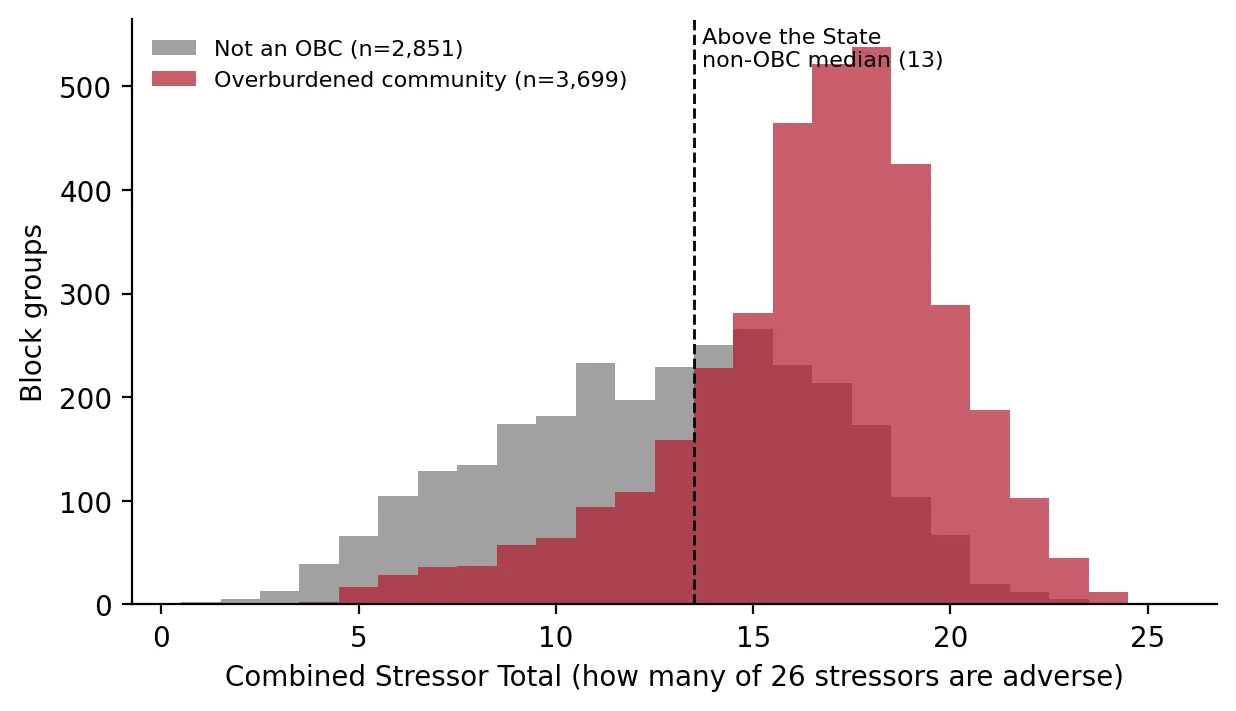 Figure 2. Distribution of Combined Stressor Totals for overburdened and other block groups. NJDEP data, March 2026.
Most OBCs trigger the strict standard. Under NJDEP’s rules, 3,167 of 3,699 OBCs (85.6%), home to about 4.59 million people, are “subject to adverse cumulative stressors” (Figure 1). In those places, a new covered facility that cannot avoid contributing to an adverse stressor must be denied unless it serves a compelling public interest. In other words, for roughly half of New Jersey’s population, the default answer to a new polluting facility is now “no.”
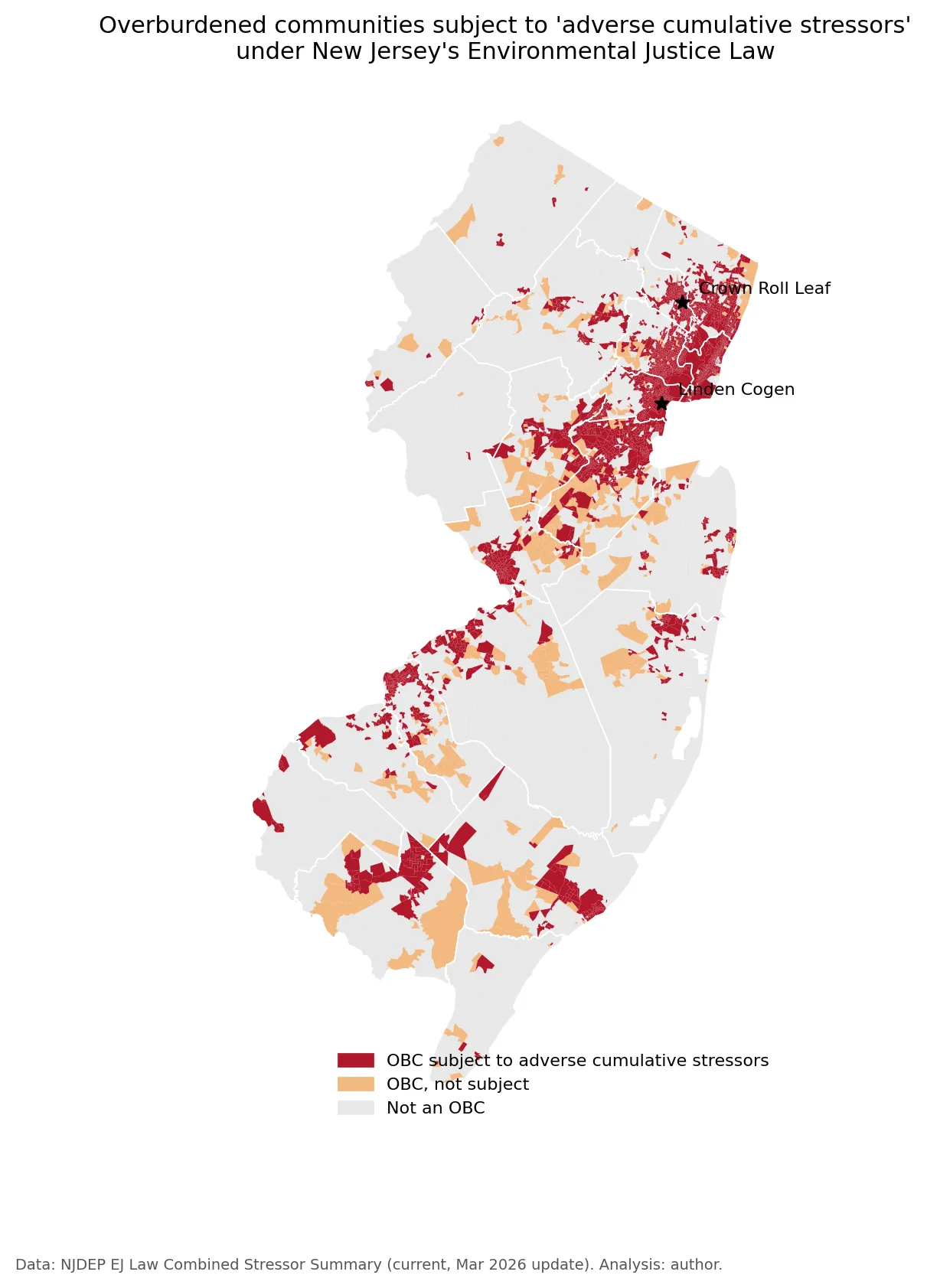 Figure 1. Overburdened communities subject to adverse cumulative stressors (red). Stars mark the two facilities with EJ Law hearings in November 2026.
The comparison rule matters. The challengers argued for a simpler, uniform geographic comparison. To measure what is at stake, I reran the cumulative test under two alternatives (Figure 3):
| Comparison rule | OBCs subject to adverse cumulative stressors | People |
|---|---|---|
| State median only | 3,095 (83.7%) | 4.48 million |
| County median only | 2,649 (71.6%) | 3.89 million |
| NJDEP hybrid (lower of the two) | 3,167 (85.6%) | 4.59 million |
The effect of a county-only rule would be concentrated exactly where NJDEP predicted. In Hudson County, ordinary non-overburdened neighborhoods already have a median of 17 adverse stressors. Measuring Hudson’s OBCs against that local baseline would cut the share qualifying from 99% to 59%, which is 170 communities. Bergen (144) and Essex (120) would lose almost as many. A state-only rule would instead reduce protection in less industrial counties such as Atlantic, Ocean, and Monmouth. The hybrid rule is the most protective option in every county, which is what the “lower of the two” design is meant to do. Because the Combined Stressor Total for non-OBCs statewide is 13, no county’s comparison value can exceed 13 under the current rule.
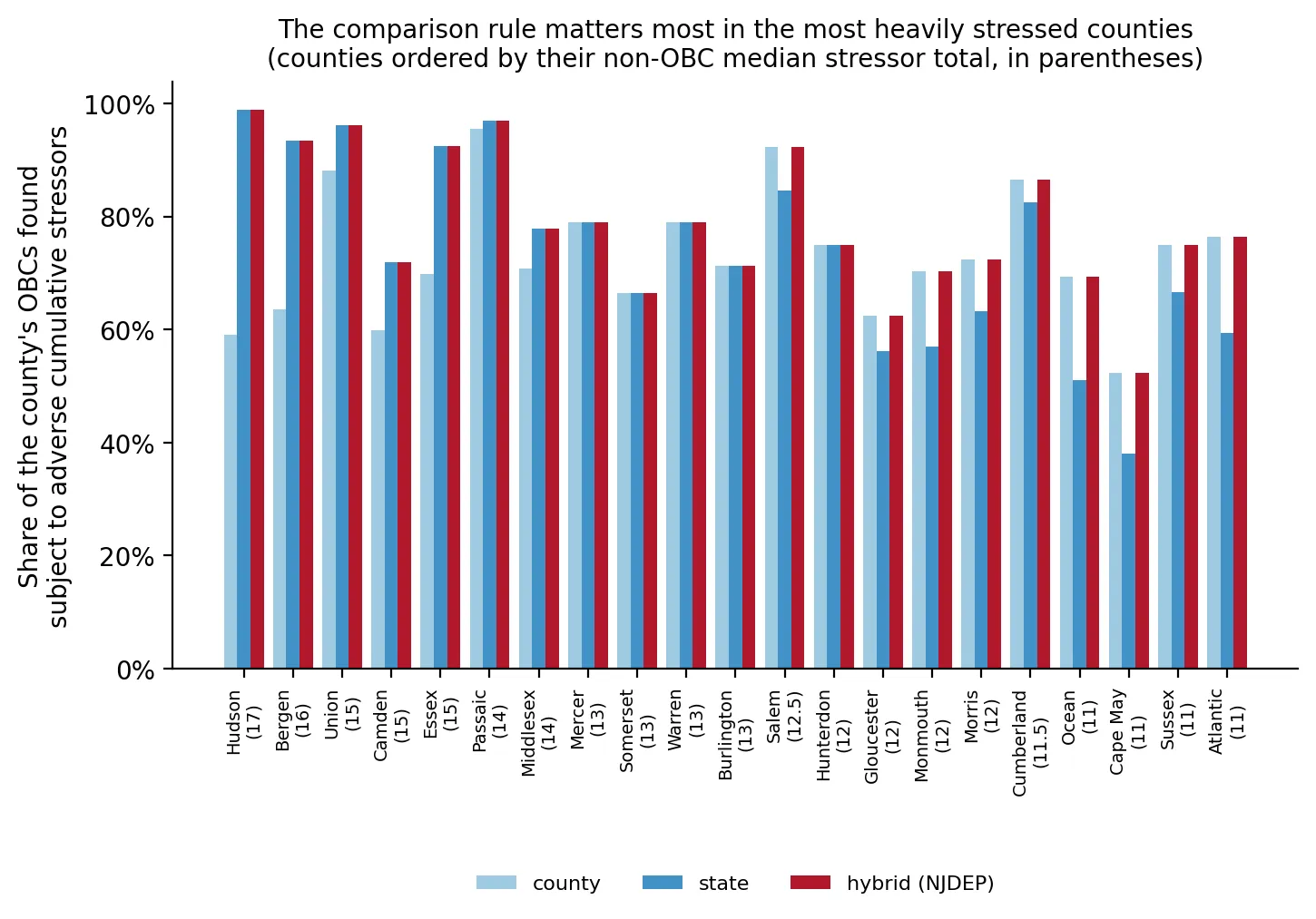 Figure 3. Share of each county’s OBCs subject to adverse cumulative stressors under three comparison rules.
Zero-population block groups: small in number, large in stakes. Only 53 block groups qualify as zero-population “Adjacent” areas. They are spread across 32 municipalities, most in Burlington, Camden, Gloucester, Mercer, and Middlesex counties. In 48 of the 53, the neighboring OBC’s stressor total is higher than the block group’s own. The number is small because the issue before the Supreme Court is not about how many people live in these areas, since no one does. It is about whether the industrial parcels where heavy facilities actually tend to sit can escape the law because of where the Census Bureau drew a line. NJDEP raised this concern directly, warning that block group boundaries “can be manipulated during the census process” (In re NJDEP’s EJ Rules, 2026, p. 38).
6. The law at work this month: Paterson and Linden
Two EJ Law hearings scheduled for November 2026 show what the law can and cannot do.
Crown Roll Leaf, Paterson (hearing November 10). Crown Roll Leaf has coated polyester film at 91 Illinois Avenue since 1971. It is seeking an air permit modification to move 10 electroplating baths from a second building into its main plant. Its public notice states that “the relocation of the baths will have no effect on the community” (Crown Roll Leaf, 2026). The block group containing the facility has a Combined Stressor Total of 19, compared with a comparison value of 13. It is adverse for fine particulate matter, diesel exhaust, truck traffic, contaminated sites, solid waste and scrap metal facilities, and lack of open space, among others (Figure 4). Because this is a change to an existing facility, NJDEP cannot deny it under the EJ Law. The legal question is whether the change is an “expansion” that increases the facility’s contribution to any stressor. If it is, NJDEP can attach conditions. One small detail from the notice is also worth noting. The version posted on the company’s website in August still read “The public may also attend via a Microsoft Teams link: {insert link here}.” Whether the law delivers “meaningful public participation” depends on details like that.
Cogen Technologies Linden Venture, Linden (hearing November 17). This roughly 972-megawatt natural gas cogeneration plant at the Bayway refinery supplies electricity to the New York market and steam to the refinery. It is seeking renewal of its Title V (major source) operating permit. Its host block group has a Combined Stressor Total of 22, one of the highest in the state. It is adverse on 22 of the 26 stressors, including ozone, PM2.5, air toxics cancer risk, railways, flooding, and major water discharge sites. Again, the EJ Law allows only conditions, not denial, for a renewal. A plant of this size could face meaningful requirements, but the law’s strongest tool does not apply.
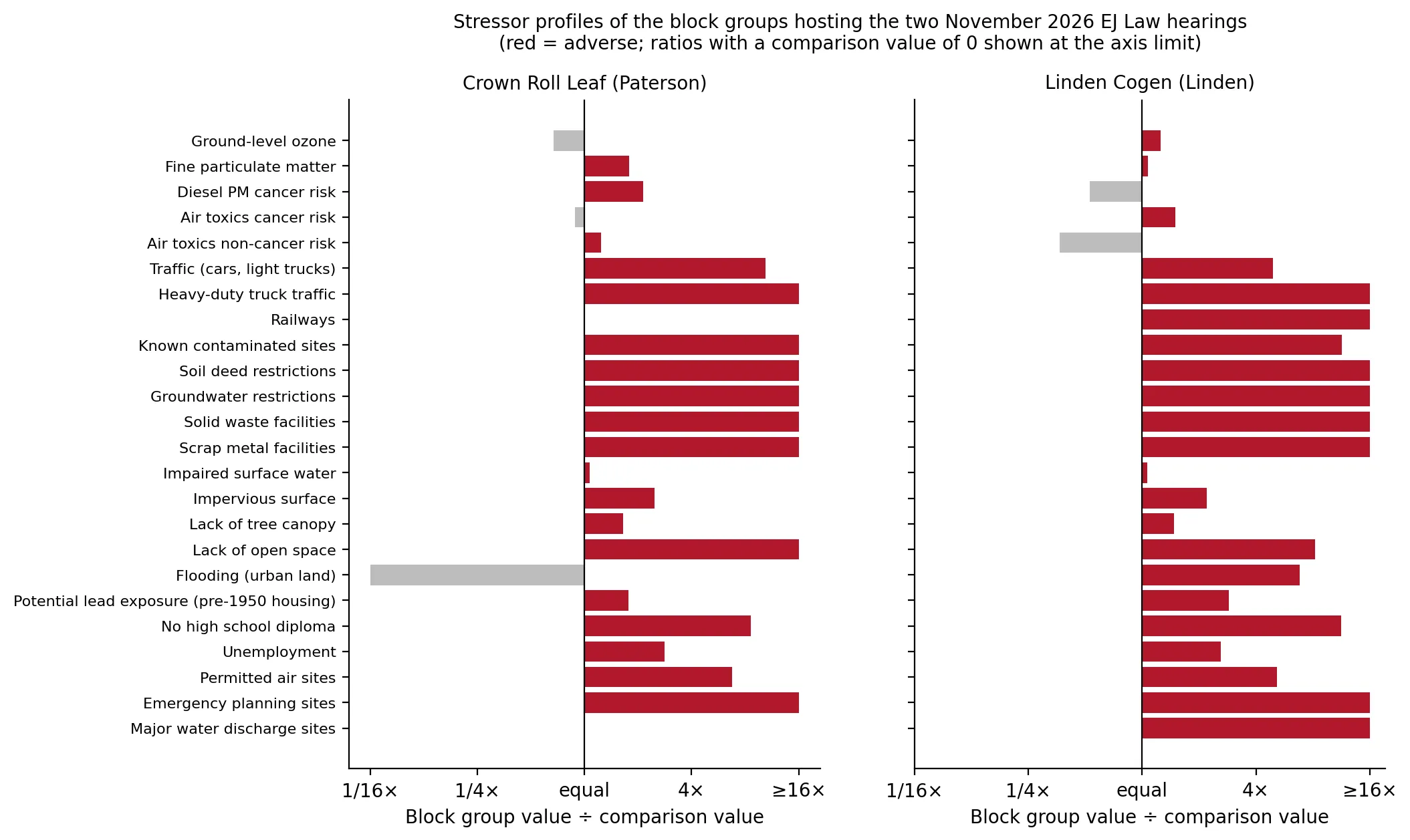 Figure 4. Stressor profiles for the block groups containing each facility. Bars show how far each value is above (red, adverse) or below (gray) its comparison value.
These two cases show something important about the EJ Law’s design. Its most powerful tool, mandatory denial, applies only to new facilities. Most of the facilities that shaped places like the Ironbound, Paterson, and Linden already exist, and for them the law offers conditions. That is why the definitional questions now before the Supreme Court matter so much. If “new facility” is read narrowly, more applications fall into the category where denial is impossible.
7. Limitations and open questions
My analysis describes how the screening test behaves. It does not predict how NJDEP will decide any particular permit, which depends on facility-specific evidence in each EJIS. Several features of the test are also open to debate.
- The test counts stressors; it does not measure them. A neighborhood barely above the median for truck traffic receives the same “adverse” point as one 16 times above it. Count-based indices are transparent, but they discard information about severity, and researchers have debated how cumulative impact tools should weight and combine indicators (Solomon et al., 2016).
- Medians build in a baseline of burden. About half of non-overburdened block groups are above the median on any given stressor by definition. The test asks whether OBCs are worse off than the typical non-OBC, not whether anyone’s exposure is safe.
- Social and environmental indicators are mixed together. Including unemployment and education reflects research on vulnerability, but it means a community’s CST can rise or fall for reasons unrelated to pollution. The challengers raised this point, and the court rejected it.
- Data limits. Stressors come from datasets of varying age and resolution. Facility locations in my case studies come from geocoded addresses (Crown Roll Leaf) and EPA’s facility registry (Linden), so they identify the host block group but not the full property footprint.
8. Conclusion
New Jersey’s EJ Law asks a question that environmental regulation long avoided: not just Is this facility clean enough? but Has this community carried enough? The Appellate Division held that NJDEP answered that question within the bounds the Legislature set. The public data show that the answer reaches a large share of the state: about 85% of overburdened communities, and nearly half of all New Jersey residents, live where the law’s strictest standard now applies. The Supreme Court’s decision will determine how far that standard reaches, including into unpopulated industrial zones, facilities that operated without permits, and the mapping tool that makes the test possible. Meanwhile, hearings like those in Paterson and Linden are where the law’s promise of “meaningful participation” is tested in practice.
Data and methods
Data sources
- EJ Law Combined Stressor Summary (Current) (NJDEP Bureau of GIS, FeatureServer (ArcGIS item 8f1eeb5074d147af8ab3e5e5a4f72d2b)) March 31, 2026 update, with OBC status from the 2024 ACS. One row per 2020 block group: 26 stressor values, NJDEP's comparison values, adverse flags, and the Combined Stressor Total.
- Crown Roll Leaf location (US Census Geocoder) 91 Illinois Ave, Paterson
- Cogen Technologies Linden Venture location (US EPA ECHO) AIR ID NJ0000003403941809
The analysis was done in Python with public data. The full code, its data, and every figure it produces are in the code project below.
References
- Alexander v. Sandoval, 532 U.S. 275 (2001).
- Antzoulis, M. (2026, September 3). New Jersey Supreme Court to review NJDEP's environmental justice rules. Riker Danzig. https://riker.com/blog/environmental-law/new-jersey-supreme-court-to-review-njdeps-environmental-justice-rules/
- Bullard, R. D., Mohai, P., Saha, R., & Wright, B. (2007). Toxic wastes and race at twenty: 1987–2007. United Church of Christ Justice and Witness Ministries.
- Commission for Racial Justice, United Church of Christ. (1987). Toxic wastes and race in the United States.
- Crown Roll Leaf, Inc. (2026). N.J.A.C. 7:1C-4.1 public notice [EJ Project ID 34478680]. https://crownrollleaf.com/wp-content/uploads/2026/08/Crown-Roll-Leaf-NJDEP-Public-Notice.pdf
- Environmental Justice Law, N.J.S.A. 13:1D-157 to -161 (2020).
- Environmental Justice Rules, N.J.A.C. 7:1C (2023).
- In re New Jersey Department of Environmental Protection's April 17, 2023, 55 N.J.R. 661(b) "Environmental Justice Rules," Nos. A-2936-22, A-2959-22 (N.J. Super. Ct. App. Div. Jan. 5, 2026). https://www.njcourts.gov/system/files/court-opinions/2026/a2936-22a2959-22.pdf
- Mohai, P., & Saha, R. (2015). Which came first, people or pollution? Assessing the disparate siting and post-siting demographic change hypotheses of environmental injustice. Environmental Research Letters, 10(11), 115008. https://doi.org/10.1088/1748-9326/10/11/115008
- New Jersey Department of Environmental Protection. (2026). Environmental Justice (EJ) Law Combined Stressor Summary (Current) [Data set]. NJDEP Bureau of GIS. https://services1.arcgis.com/QWdNfRs7lkPq4g4Q/arcgis/rest/services/Environmental_Justice_EJ_Law_Combined_Stressor_Summary/FeatureServer
- New Jersey Department of Environmental Protection, Environmental Justice Advisory Council. (2009). Strategies for addressing cumulative impacts in environmental justice communities. https://dep.nj.gov/wp-content/uploads/ej/docs/ejac_impacts_report200903.pdf
- Sheats, N., Baptista, A. I., Lopez-Nunez, M., & Miles, M. (2025). They said it couldn't be done: A case study of New Jersey's landmark environmental justice law (S. 232). Environmental Justice. https://doi.org/10.1177/19394071251392461
- Solomon, G. M., Morello-Frosch, R., Zeise, L., & Faust, J. B. (2016). Cumulative environmental impacts: Science and policy to protect communities. Annual Review of Public Health, 37, 83–96. https://doi.org/10.1146/annurev-publhealth-032315-021807
- South Camden Citizens in Action v. New Jersey Department of Environmental Protection, 145 F. Supp. 2d 446 (D.N.J. 2001a).
- South Camden Citizens in Action v. New Jersey Department of Environmental Protection, 274 F.3d 771 (3d Cir. 2001b).
- Tessum, C. W., Paolella, D. A., Chambliss, S. E., Apte, J. S., Hill, J. D., & Marshall, J. D. (2021). PM2.5 polluters disproportionately and systemically affect people of color in the United States. Science Advances, 7(18), eabf4491. https://doi.org/10.1126/sciadv.abf4491
- Facility details for Cogen Technologies Linden Venture: U.S. EPA ECHO (AIR ID NJ0000003403941809); NJDEP EJ public meetings listing (permit BOP230004, EJ Project ID 34474841). Plant capacity as reported by Global Energy Monitor and trade press.