
Five Years After the EJ Law: Contaminated Sites Next Door
Five years
On September 18, 2020, Governor Murphy signed New Jersey’s Environmental Justice Law (New Jersey Legislature, 2020). This month marks five years. Among the “environmental or public health stressors” the law lists by name is contaminated sites: places where chemicals from old factories, gas stations, dumps, and spills remain in the soil or groundwater.
New Jersey has thousands of them, a legacy of more than a century of industry. Contamination can reach people through vapors seeping into basements, polluted groundwater and wells, and soil in yards and vacant lots. Contaminated land also blocks redevelopment, leaving empty lots and fewer parks and businesses.
In the introduction, I showed that overburdened communities are almost three times as likely as other neighborhoods to be above the state median for contaminated sites. A fair question is whether that is just because overburdened communities tend to be in older, more industrial cities and counties. This post tests that.
Data
NJDEP’s EJ data (the version in effect in September 2025) include a measure of how densely known contaminated sites are packed in and around each block group (NJDEP, 2025). Higher numbers mean more sites nearby. I compared 6,514 populated block groups.
Findings
Overburdened communities have about four times the contaminated-site density
| Overburdened communities | Other neighborhoods | |
|---|---|---|
| Average contaminated-site density | 17.0 | 4.3 |
| Median | 11.8 | 1.8 |
The 10% of neighborhoods with the most contaminated sites nearby are home to about 933,000 people, and 94% of those neighborhoods are overburdened communities.
Testing a competing explanation
Maybe overburdened communities are just in more industrial counties, or are more built up. To check, I used multiple regression with two kinds of controls:
- County fixed effects: this compares each neighborhood only with others in the same county, so differences between, say, Hudson and Sussex counties can’t explain the result.
- Impervious surface: the share of land covered by pavement and buildings, a measure of how built up and industrial an area is.
Because contaminated-site density is very skewed, I used its logarithm, so the results can be read as “times as many.”
| Comparison | Overburdened ÷ other neighborhoods | 95% confidence interval |
|---|---|---|
| Raw gap | 3.4× | 2.4–4.8 |
| Same county | 2.0× | 1.7–2.4 |
| Same county and same level of pavement | 1.3× | 1.15–1.4 |
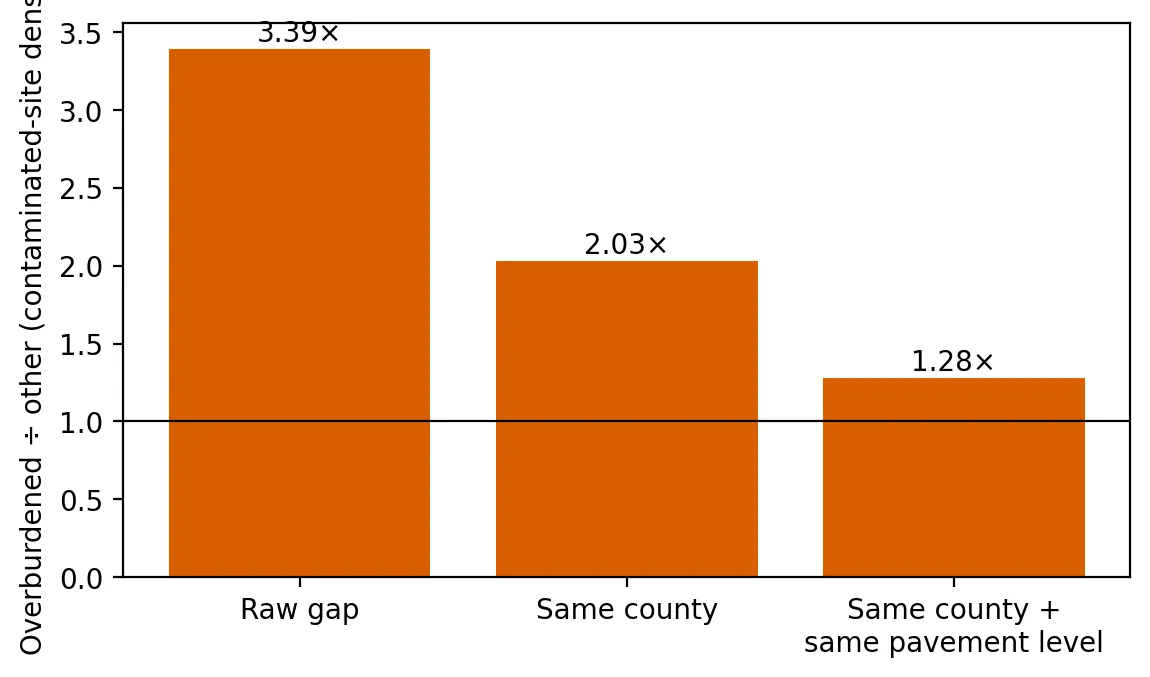 Figure 2. The gap in contaminated sites shrinks as controls are added but never disappears.
The gap shrinks as I add controls, which is expected since older industrial areas really are more contaminated. But it never goes away. Even compared with neighborhoods in the same county that are equally paved over, overburdened communities still have 28% more contaminated-site density, and the result is highly significant (p < 0.0001). Both a higher share of residents of color and a higher share of low-income households are independently linked to more contamination nearby.
County by county
In 20 of New Jersey’s 21 counties, overburdened communities average more contaminated sites nearby than other neighborhoods in the same county. In Cumberland County the difference is almost 10 to 1, and in Atlantic County nearly 8 to 1.
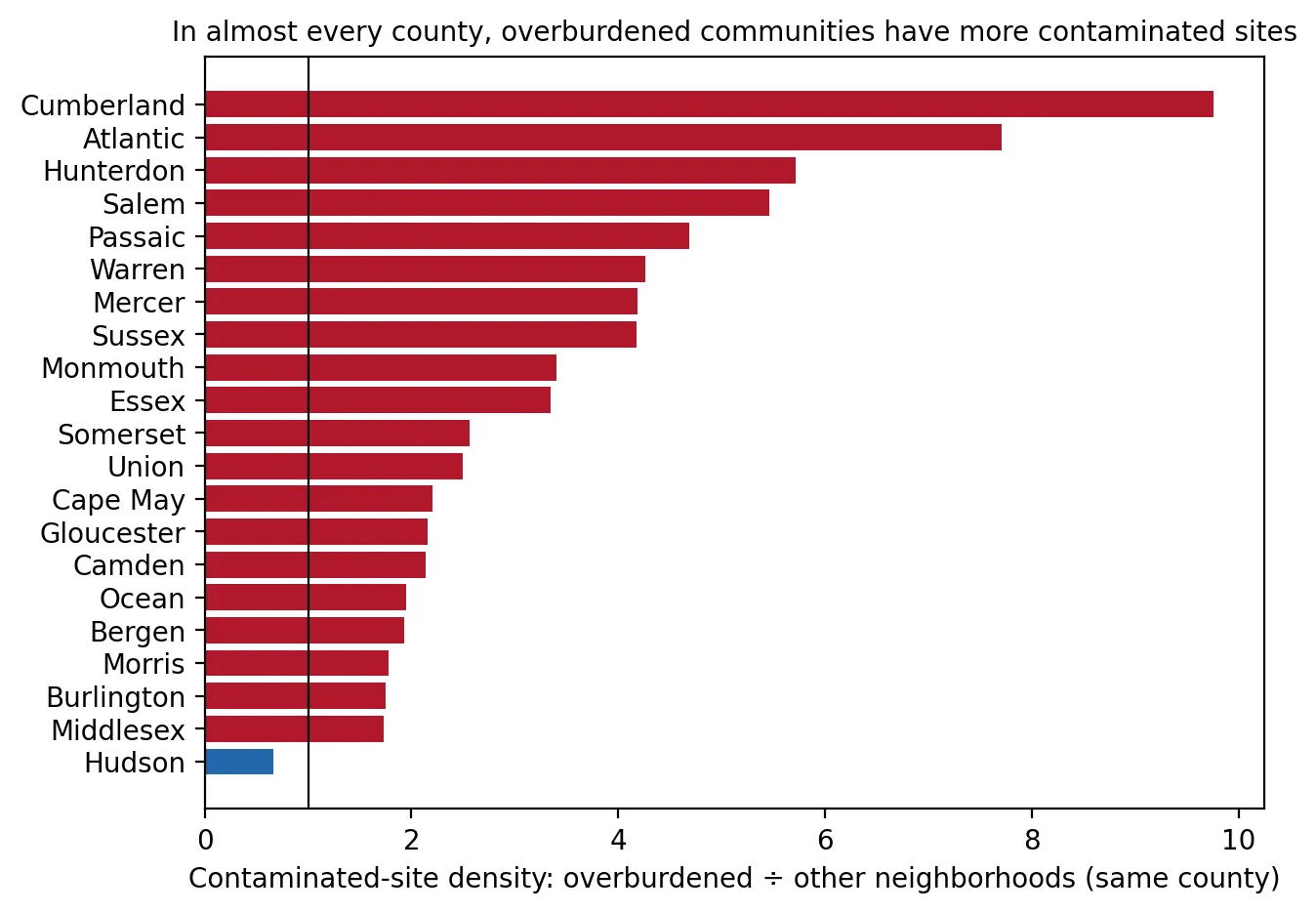 Figure 1. In 20 of 21 counties, overburdened communities have more contaminated sites nearby than other neighborhoods in the same county.
The one exception is Hudson County, where 90% of residents live in overburdened communities. The county’s few remaining neighborhoods also have very high contaminated-site density, reflecting how much of Hudson County has an industrial past.
What this shows
Contaminated land in New Jersey is concentrated in overburdened communities, and the pattern holds within every county but one and even among equally built-up neighborhoods. Five years after New Jersey recognized contaminated sites as a burden that falls unfairly on these communities, the data still show it.
Limitations
- Density, not risk. The measure counts sites, not how dangerous each one is or whether people are exposed.
- Controls can over-correct. Pavement and industrial land are partly part of the burden, so controlling for them may understate the true gap.
- Known sites only. Undiscovered contamination isn’t counted.
Code project (Level 3): compare within the same county
Goal: Test whether contaminated-site density is higher in overburdened communities even after comparing neighborhoods within the same county and with similar development.
Data: NJDEP EJ Law stressor data (version effective January 31, 2025), including the Known Contaminated Sites measure, OBC status, demographics, and impervious surface.
Steps:
- Log-transform contaminated-site density.
- Fit regressions that add county fixed effects (
C(COUNTY)) and impervious surface step by step. - Use cluster-robust standard errors by county, since neighborhoods in the same county aren’t fully independent.
- Convert coefficients to “times as many” with
exp(). - Compare overburdened and other neighborhoods within each county.
m = smf.ols("log_kcsl ~ obc + imperv10 + C(COUNTY)", d).fit(cov_type="cluster", cov_kwds={"groups": county_codes})
print(np.exp(m.params["obc"]))     # how many times higher, same county and pavement level
New skills: fixed effects, controlling for a competing explanation, and clustered standard errors.
Data and methods
Data sources
- NJDEP EJ Law stressor data (version effective January 31, 2025), including the Known Contaminated Sites measure, OBC status, demographics, and impervious surface.
The analysis was done in Python with public data. The full code, its data, and every figure it produces are in the code project below.
References
- New Jersey Department of Environmental Protection. (2025). Environmental Justice EJ Law Combined Stressor Summary 20250131 to 20260330 [Data set]. https://www.arcgis.com/home/item.html?id=8a9ae7bae7a0458fb0f8d3759b145257
- New Jersey Legislature. (2020). P.L.2020, c.92 (approved September 18, 2020). https://pub.njleg.gov/bills/2020/PL20/92_.PDF