
A Power Plant for Every Square Mile? The Ironbound and the Hardest Case for Environmental Justice Law
Abstract. The Passaic Valley Sewerage Commission (PVSC) wants to build an 84-megawatt gas-fired backup power plant at its sewage treatment plant in Newark’s Ironbound, a neighborhood that already hosts three gas-fired power plants and the state’s largest trash incinerator. The plant was approved under New Jersey’s interim environmental justice rules, and construction has been paused by a court since October 2025. Using NJDEP’s own facility data, I tested a central factual claim in the community’s lawsuit: that the Ironbound’s ZIP codes contain more facilities regulated by the Environmental Justice Law than anywhere else in the state. The claim largely holds. ZIP code 07105 ranks first in New Jersey with 32 EJ-regulated facilities, and 07114 ranks third with 16, for 48 combined. The two ZIP codes contain about 6% of the state’s power plant capacity on 0.2% of its area, and the Ironbound’s block groups average 19.1 adverse environmental stressors out of 26, higher than 83% of overburdened communities statewide. The PVSC case is also a genuinely hard one: a facility meant to protect the public from one hazard, sewage spills during blackouts, would add to another, air pollution, in one of the most burdened places in the state.
1. The Ironbound
The Ironbound is a neighborhood of roughly 50,000 people in Newark’s East Ward, bounded by the Passaic River, railroad lines, and the industrial waterfront of Port Newark. For more than a century it has been home to working-class immigrant communities, most recently Portuguese, Brazilian, and Latin American families. It has also been home to heavy industry. The Diamond Alkali plant on Lister Avenue, which manufactured Agent Orange, left dioxin contamination in the lower Passaic River that is now one of the country’s largest Superfund cleanups.
Today the neighborhood sits beside one of the densest industrial corridors in New Jersey. It hosts three gas-fired power plants (the Newark Energy Center, PSEG’s Essex Generating Station, and Newark Bay Cogeneration), the Reworld (formerly Covanta) Essex resource recovery facility, the state’s largest trash incinerator, and PVSC’s wastewater treatment plant, one of the largest in the country. Trucks serving the port and nearby warehouses pass through daily (see Post 3).
2. The proposed plant
The story begins with Hurricane Sandy. In October 2012, flooding knocked out grid power to PVSC’s treatment plant for about two days, and the plant was unable to fully treat incoming sewage, which flowed into the region’s waterways. PVSC then sought Federal Emergency Management Agency funding for a resilience project that included flood walls, pumps, and an on-site “standby power generating facility” to keep the plant running if the grid fails again.
According to the Ironbound Community Corporation’s (ICC) 2025 lawsuit, the key events since then were as follows (ICC v. PVSC, 2025):
- 2019: PVSC contracted to buy three gas turbines from Siemens Energy with a combined capacity of 84 MW, before applying for an air permit.
- 2020–2021: PVSC applied to NJDEP to modify its air permit. A revised version sought permission to run the plant not only in emergencies but also for “demand response,” disconnecting from the grid during peak demand in exchange for lower electricity prices. (A request to sell power to the grid was later dropped.)
- 2021: NJDEP determined that the plant would be a new major source of air pollution in an overburdened community, subject to Administrative Order 2021-25, the interim order NJDEP used to apply the Environmental Justice Law before its final rules took effect in 2023.
- 2022: At the required public hearing, 50 of 53 speakers opposed the plant, and all but four of 446 written comments opposed it.
- July 18, 2024: NJDEP issued its environmental justice decision allowing the permit process to proceed.
- April 2, 2025: NJDEP finalized the air permit.
- June 12, 2025: PVSC’s board voted 6–2 to award the construction contract.
- July–August 2025: ICC and the City of Newark sued, and ICC separately appealed NJDEP’s permit.
- October 27, 2025: The Essex County Superior Court stayed construction while the case proceeds (Earthjustice, 2025).
As of early November 2026, I found no report of a final ruling.
3. The core dispute: how much backup power is enough?
The central technical disagreement is about PVSC’s design requirement. According to the complaint, PVSC specified that its backup system must provide 34 MW, the plant’s expected peak load, for two full weeks. Only a gas plant could meet that standard, which ruled out battery storage.
ICC and its expert engineer argued that two weeks was unjustified. They point out that Sandy’s outage lasted about two days, that PSE&G has since raised flood-prone substations, and that no substations lost power during Hurricane Ida in 2021. Their expert concluded that the longest credible outage was about 12 hours, which batteries could cover. ICC also argues that gas pipelines are not immune to storm disruption. NJDEP itself asked PVSC in 2022 to justify the two-week and 34 MW requirements. According to the complaint, PVSC’s response cited Sandy’s two-day outage but did not explain the two-week standard (ICC v. PVSC, 2025).
PVSC’s position is that its treatment plant, which serves more than a million people, cannot risk another Sandy, and that a reliable on-site power source is essential to public health. That argument has real force. A sewage treatment plant that fails during a storm can release enormous volumes of raw sewage into the region’s waterways.
4. Testing a claim: is the Ironbound really the most burdened ZIP code?
The lawsuit states that Newark has more EJ Law–regulated facilities than any other municipality and that “the two zip codes that cover the Ironbound have the first and second-highest number of EJ Law–regulated facilities” in the state, with 44 between them. I tested that claim with NJDEP’s own data. Full code is in code/.
Method. I combined the facility layers in NJDEP’s EJMAP Facility Map (April 2026) for the categories the law covers: major air pollution sources, solid and hazardous waste facilities, recycling facilities, resource recovery facilities, landfills, sludge facilities, scrap metal facilities, and sewage plants over 50 million gallons per day. I counted each site once even if it appeared in several layers, then assigned facilities to 2020 ZIP Code Tabulation Areas.
Result. The claim largely holds.
| Rank | ZIP code | Area | EJ-regulated facilities |
|---|---|---|---|
| 1 | 07105 | Newark (Ironbound) | 32 |
| 2 | 07036 | Linden | 17 |
| 3 | 07114 | Newark (Port Newark / airport area) | 16 |
| 4 | 08104 | Camden | 15 |
| 5 | 08360 | Vineland | 14 |
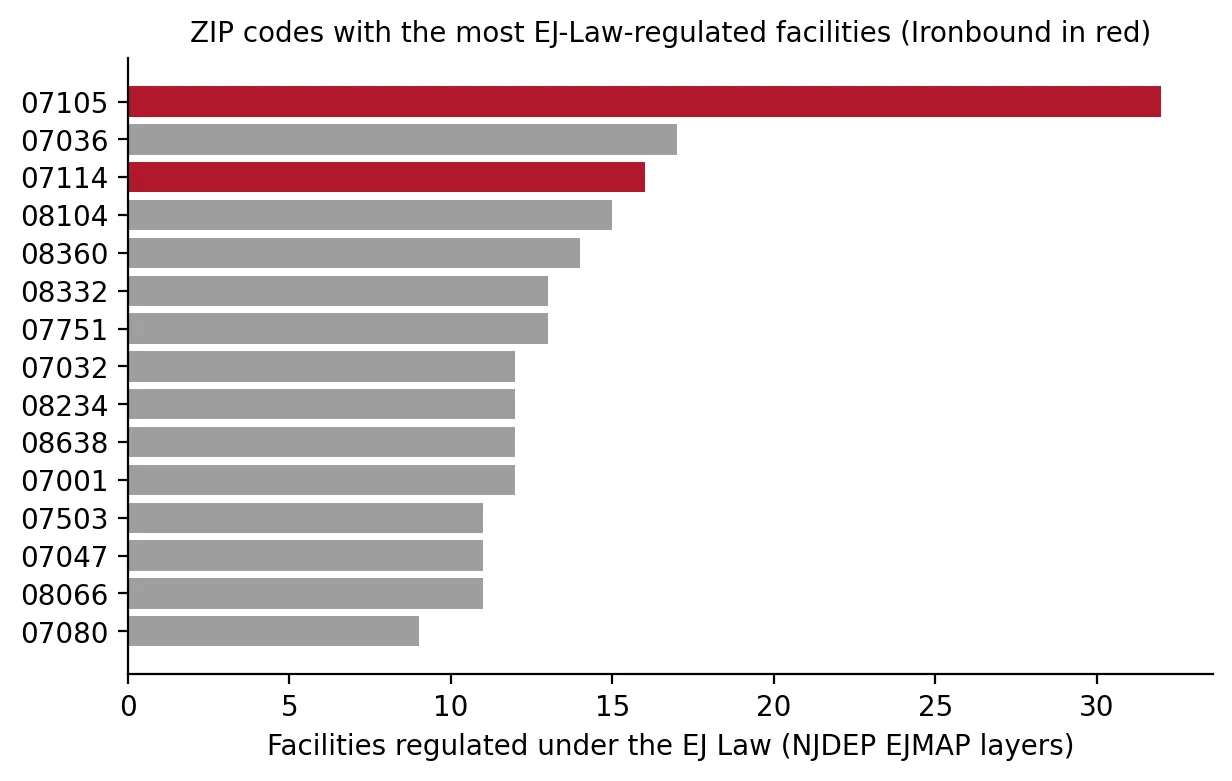 Figure 2. ZIP codes with the most facilities regulated under New Jersey’s Environmental Justice Law, from NJDEP EJMAP facility layers (April 2026).
07105 has nearly twice as many regulated facilities as any other ZIP code in New Jersey. The median ZIP code with at least one such facility has just two. My combined count for the two Ironbound ZIP codes (48) is close to the complaint’s 44; in my count, Linden edges out 07114 for second place. The difference probably reflects different data dates. Most of the Ironbound’s facilities are scrap metal yards (38), along with seven major air sources and several waste facilities.
Power plants. NJDEP’s power plant layer lists four plants in 07105 with 969 MW of combined capacity: the Newark Energy Center (708 MW), Newark Bay Cogeneration (120 MW), PSEG Essex (81 MW), and the Reworld Essex incinerator (60 MW). That is 5.9% of the capacity in NJDEP’s statewide layer, located on about 13 square miles, or 0.17% of the state’s area. PVSC’s plant would add 84 MW.
Cumulative stressors. All 42 populated block groups in the two ZIP codes (about 72,600 residents) are overburdened communities. Their average Combined Stressor Total is 19.1 out of 26, compared with 16.5 for all overburdened communities and a statewide comparison value of 13. That average is higher than 83% of overburdened block groups in New Jersey. Six stressors are adverse in every Ironbound block group: permitted air sites, emergency planning sites, scrap metal facilities, known contaminated sites, traffic, and lack of tree canopy (Figure 1).
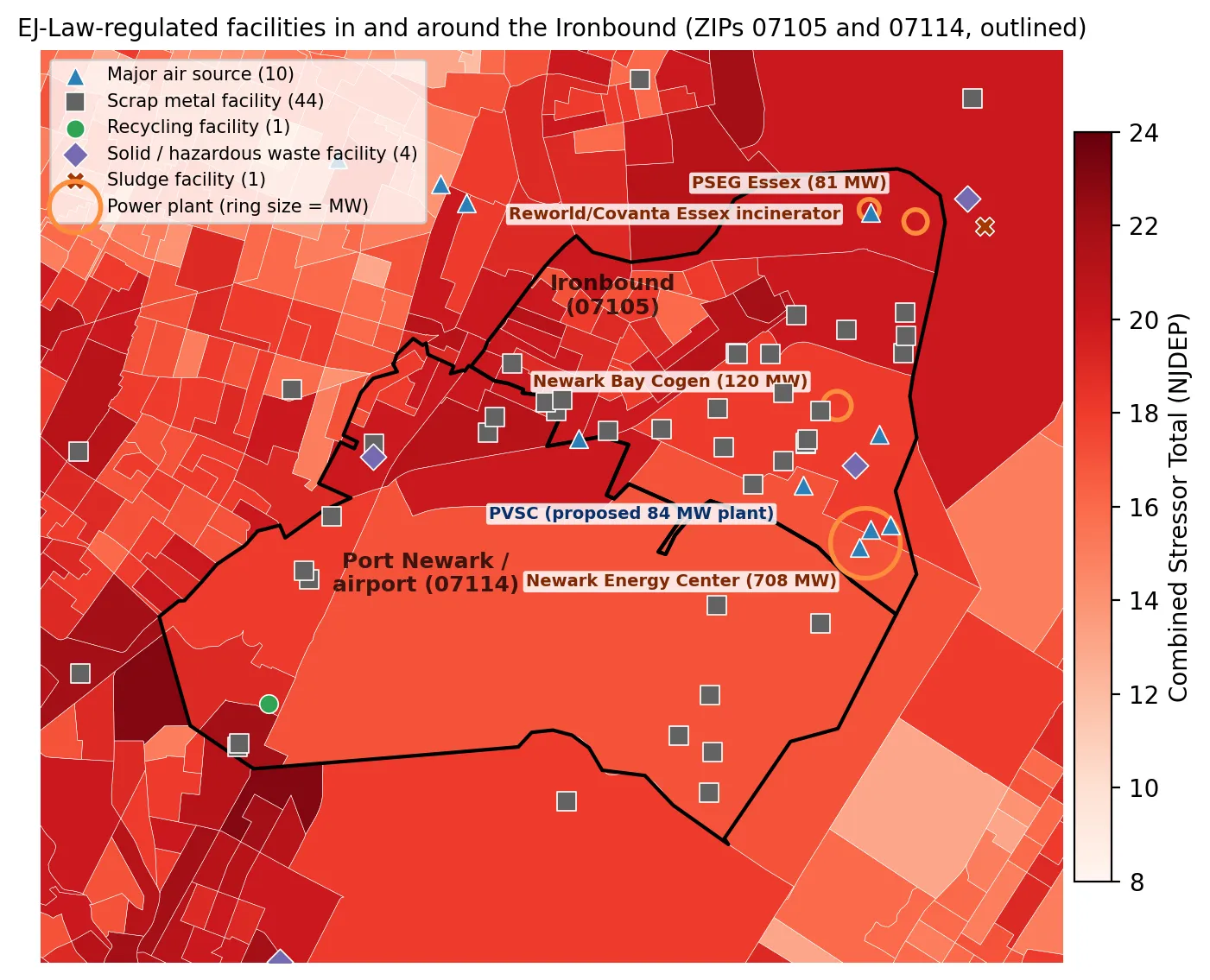 Figure 1. EJ Law–regulated facilities and power plants in and around ZIP codes 07105 and 07114, over NJDEP’s Combined Stressor Total for each block group.
5. Why this is the hardest kind of case
Most environmental justice disputes pit a community against a private facility seeking profit. The PVSC plant is different: a public agency is proposing an emergency power source intended to protect public health. That creates a real tension within the logic of the Environmental Justice Law (see Post 1).
On one hand, the law treats a new major air source in an overburdened community with adverse cumulative stressors as presumptively deniable, and the Ironbound is about as stressed as any community in the state. On the other hand, the law’s “compelling public interest” exception exists for projects that serve an essential environmental, health, or safety need of the community. NJDEP’s own examples include public water infrastructure and projects that reduce combined sewer overflows (Post 6). A treatment plant that keeps running during a hurricane arguably fits that description.
The resolution depends on alternatives. If a non-polluting option, such as batteries plus grid hardening, could meet the real emergency need, the case for adding a fourth gas plant weakens considerably. That is why the debate centers on technical questions like “34 MW for two weeks” versus “12 hours.” It is also why the case is being watched as a test of whether environmental justice law can push public agencies, not just private companies, toward cleaner choices.
6. Limitations
- Counts are not emissions. A scrap yard and a 708 MW power plant each count as one facility. Facility counts measure concentration, not total pollution, and a backup plant that runs rarely emits far less than a baseload plant.
- ZIP codes approximate the neighborhood. ZIP 07105 covers the Ironbound plus industrial land along the river, and 07114 is dominated by Port Newark and the airport. Neither matches neighborhood boundaries exactly.
- Data snapshot. NJDEP’s facility layers reflect April 2026. The complaint’s count, from an earlier date, differs slightly.
- One side’s account. The timeline and technical claims in Sections 2–3 come largely from the community’s legal complaint, which is an advocacy document. PVSC disputes its characterization, and the court has not yet ruled on the merits.
7. Conclusion
NJDEP’s own data confirm what Ironbound residents have argued for years: their neighborhood has a greater concentration of facilities regulated under the Environmental Justice Law than any other ZIP code in New Jersey, along with nearly a gigawatt of power plant capacity in about 13 square miles. Whether a fourth gas plant should join them is a harder question than it first appears, because the proposed plant is meant to protect public health during disasters. But that difficulty is exactly why the case matters. It will help decide whether New Jersey’s environmental justice framework can require even well-intentioned public projects to prove that cleaner alternatives truly cannot do the job.
Data and methods
The analysis was done in Python with public data. The full code, its data, and every figure it produces are in the code project below.
References
- Earthjustice. (2025, June 13). Defying logic, New Jersey green lights yet another gas power plant in Newark [Press release]. https://earthjustice.org/press/2025/defying-logic-new-jersey-green-lights-yet-another-gas-power-plant-in-newark
- Earthjustice. (2025, October). NJ court prohibits construction of controversial Newark gas plant [Press release]. https://earthjustice.org/press/2025/nj-court-prohibits-construction-of-controversial-newark-gas-plant
- Ironbound Community Corporation v. Passaic Valley Sewerage Commission, No. ESX-L-005271-25 (N.J. Super. Ct. Law Div., Essex Cnty., complaint filed July 14, 2025). https://earthjustice.org/wp-content/uploads/2025/07/2025-07-14-icc-complaint-in-lieu-of-prerogative-writs.pdf
- Ironbound Community Corporation. (n.d.). Stop PVSC plant. https://ironboundcc.org/stop-pvsc-plant/
- New Jersey Department of Environmental Protection. (2026). NJ EJMAP facility map [Facility layers: major air sources, solid and hazardous waste, sludge, scrap metal, sewage treatment plants]. ArcGIS Online item 8c0e55eeb90348b5a47f9e0d6542f31f.
- New Jersey Department of Environmental Protection. (2026). Power plants (NJ) [Data set]. https://mapsdep.nj.gov/arcgis/rest/services/Features/Utilities/MapServer/20
- New Jersey Department of Environmental Protection. (2021). Administrative Order No. 2021-25.
- U.S. Census Bureau. (2021). 2020 ZIP Code Tabulation Areas, cartographic boundary file (1:500,000) [Data set].