
Forever Chemicals, Everyone's Problem? PFAS in New Jersey's Drinking Water
Abstract. New Jersey was the first state to regulate several “forever chemicals” in drinking water. It is also home to some of the plants that made them. In 2024, the U.S. EPA set national limits of 4 parts per trillion (ng/L) for PFOA and PFOS, and in 2026 it proposed delaying compliance to 2031 and dropping limits for four other PFAS. Using EPA’s final round of nationwide monitoring (UCMR 5, released October 2026), I analyzed all 265 New Jersey water systems tested. PFOA or PFOS was detected in 61% of them. In 119 systems serving about 5.2 million people (59% of the population covered), the highest entry-point average exceeded the 4 ng/L federal limit. Unlike most of the issues on this site, the burden is only slightly concentrated in overburdened communities: 70% of their residents on public water are served by a system above the federal level, compared with 60% of other residents. Active violations of New Jersey’s own limits are actually less common in overburdened communities, because they cluster in suburban groundwater systems in Bergen County. PFAS in New Jersey is a widely shared exposure. The environmental justice questions lie less in who drinks it than in who pays to remove it and who is left out of testing altogether.
1. What PFAS are, and why New Jersey is at the center
Per- and polyfluoroalkyl substances (PFAS) are a family of thousands of synthetic chemicals built around carbon–fluorine bonds, among the strongest in chemistry. That strength makes them useful in nonstick cookware, waterproof fabrics, food packaging, and firefighting foam. It also means they barely break down in the environment, which is why they are nicknamed “forever chemicals.” Two of the most studied, PFOA and PFOS, have been linked to kidney and testicular cancer, high cholesterol, reduced vaccine response in children, and low birth weight. In 2023, the International Agency for Research on Cancer classified PFOA as carcinogenic to humans (Group 1) and PFOS as possibly carcinogenic (Group 2B) (Zahm et al., 2024).
New Jersey has an unusually direct history with these chemicals. DuPont’s Chambers Works plant on the Delaware River in Salem County used PFOA for decades, and Solvay’s plant in West Deptford released PFNA, contamination that was discovered in Paulsboro’s drinking water wells in 2013. In response, New Jersey became the first state to set an enforceable drinking water limit (maximum contaminant level, or MCL) for PFNA (13 ng/L) in 2018. It followed with limits for PFOA (14 ng/L) and PFOS (13 ng/L) in 2020. In 2025, the state reached settlements with 3M (up to $450 million) and with DuPont, Chemours, and Corteva ($875 million over 25 years, part of a package the state values at up to $2 billion including remediation commitments) to pay for cleanup and water treatment (ROI-NJ, 2025; Environment+Energy Leader, 2025).
The problem extends well beyond those two sites. In October 2026, statewide testing reported PFAS in 91% of 86 New Jersey waterways tested, including rivers upstream of drinking water intakes (The Sun, 2026). A 2026 U.S. Geological Survey study found PFAS throughout the Wanaque, Ramapo, Pompton, and Passaic rivers, which supply water to much of northern New Jersey (USGS, 2026).
2. A moving federal target
In April 2024, the EPA finalized the first national PFAS drinking water standards: 4.0 ng/L each for PFOA and PFOS, 10 ng/L each for PFHxS, PFNA, and HFPO-DA (GenX), and a “hazard index” for mixtures, with compliance required by 2029. New Jersey’s state limits for PFOA and PFOS are roughly three times weaker than the new federal levels.
The federal standards have since been partly walked back. In May 2025, EPA announced it would keep the PFOA and PFOS limits but reconsider the others. In May 2026, it formally proposed two rules: one to extend PFOA/PFOS compliance from 2029 to 2031 through an exemption process, and one to rescind the limits for PFHxS, PFNA, GenX, and the hazard index (Waste Dive, 2026; Harvard EELP, 2026). Separately, industry challenges to the 2024 rule remain in litigation at the D.C. Circuit; according to one legal tracker, the court declined in January 2026 to simply vacate the four contested limits at EPA’s request. As of November 2026, neither proposal had been finalized. For PFNA, a chemical New Jersey regulated first, the federal standard may disappear while the state’s 13 ng/L limit remains.
3. Data and methods
Full code and documentation are in code/.
- UCMR 5. Under the fifth Unregulated Contaminant Monitoring Rule, nearly every U.S. system serving more than 3,300 people (plus a sample of smaller ones) tested its water for 29 PFAS between 2023 and 2025. I used EPA’s October 2026 data release: 57,322 New Jersey results from 265 systems serving about 8.7 million people.
- A compliance-style metric. Federal MCLs apply to the running annual average at each entry point to the distribution system. UCMR 5 includes only a few samples per entry point, so for each system I calculated the average at every entry point (counting non-detects as zero, as EPA does for compliance) and kept the highest. This approximates, but does not equal, a formal compliance determination.
- State violations. I used NJDEP’s August 2026 map of community water system service areas, which shows each system’s status (active, closed, or no violation) under New Jersey’s own PFAS MCLs.
- Who is served. I assigned every 2020 Census block to a water service area and to an overburdened community (OBC) or not, using NJDEP’s environmental justice data from Post 1.
4. Results
PFAS are widespread
PFOA was detected in 58% of tested New Jersey systems, PFOS in 37%, and PFHxS in 20%. At least one of the six regulated PFAS was found in 162 systems (61%) serving 6.9 million people.
119 of 265 systems (45%), serving about 5.2 million people, had at least one entry point where average PFOA or PFOS exceeded the 4.0 ng/L federal limit (Figure 1). They include many of the state’s largest suppliers:
| System (as listed in UCMR 5) | Population served | PFOA (ng/L) | PFOS (ng/L) |
|---|---|---|---|
| Suez Water New Jersey – Hackensack | 792,713 | 13.0 | 6.3 |
| New Jersey American Water – Raritan | 615,430 | 6.6 | 6.0 |
| New Jersey American Water – Coastal North | 377,613 | 7.2 | 0.0 |
| Passaic Valley Water Commission | 310,483 | 9.9 | 5.2 |
| Newark Water Department | 294,274 | 4.8 | 0.0 |
| Jersey City MUA | 262,000 | 5.9 | 6.9 |
Values are the highest entry-point mean in UCMR 5 samples, 2023–2025.
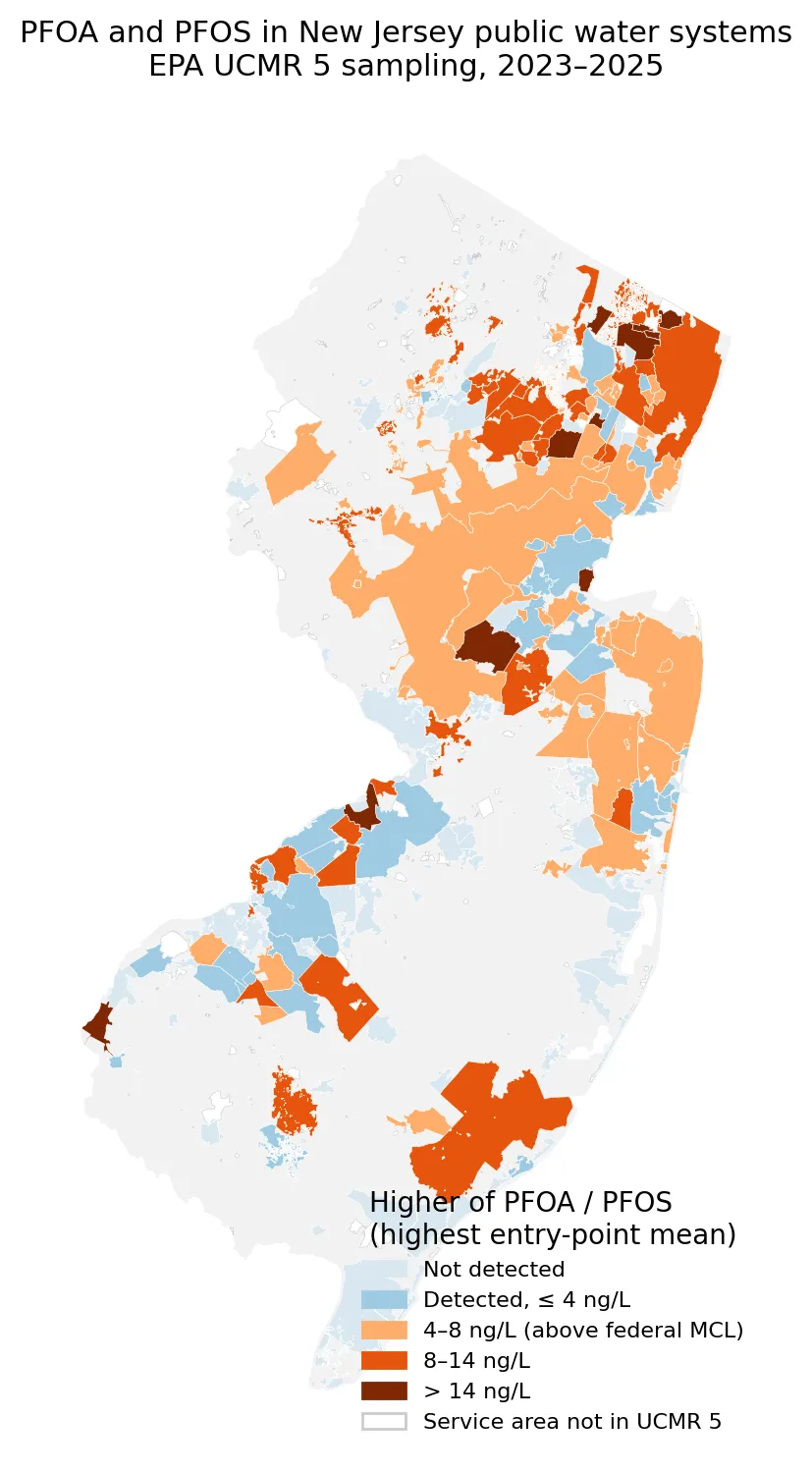 Figure 1. Higher of PFOA or PFOS (highest entry-point mean) for each community water system service area tested under UCMR 5.
The highest concentrations, above New Jersey’s own 13–14 ng/L limits, appeared in a smaller set of systems, mostly in northern Bergen and western Essex counties. They include Verona (43 ng/L PFOA), Livingston (37), Ridgewood (31), Ho-Ho-Kus, Oakland, and Waldwick, as well as Perth Amboy, South Brunswick, Burlington Township, and Pennsville in Salem County, near the former Chambers Works plant. In total, 15 systems serving about 320,000 people had UCMR 5 results above a state MCL.
Unlike most environmental burdens, PFAS are broadly shared
This is where PFAS differs from the other issues on this site (Figure 2).
| Measure | Overburdened community residents | Other residents | Ratio |
|---|---|---|---|
| System above federal PFOA/PFOS level (UCMR 5) | 70.4% (3.67 million) | 59.5% (2.02 million) | 1.18 |
| System with an active or past NJ PFAS violation | 6.8% | 8.3% | 0.82 |
| System with an active NJ PFAS violation | 1.1% | 4.8% | 0.22 |
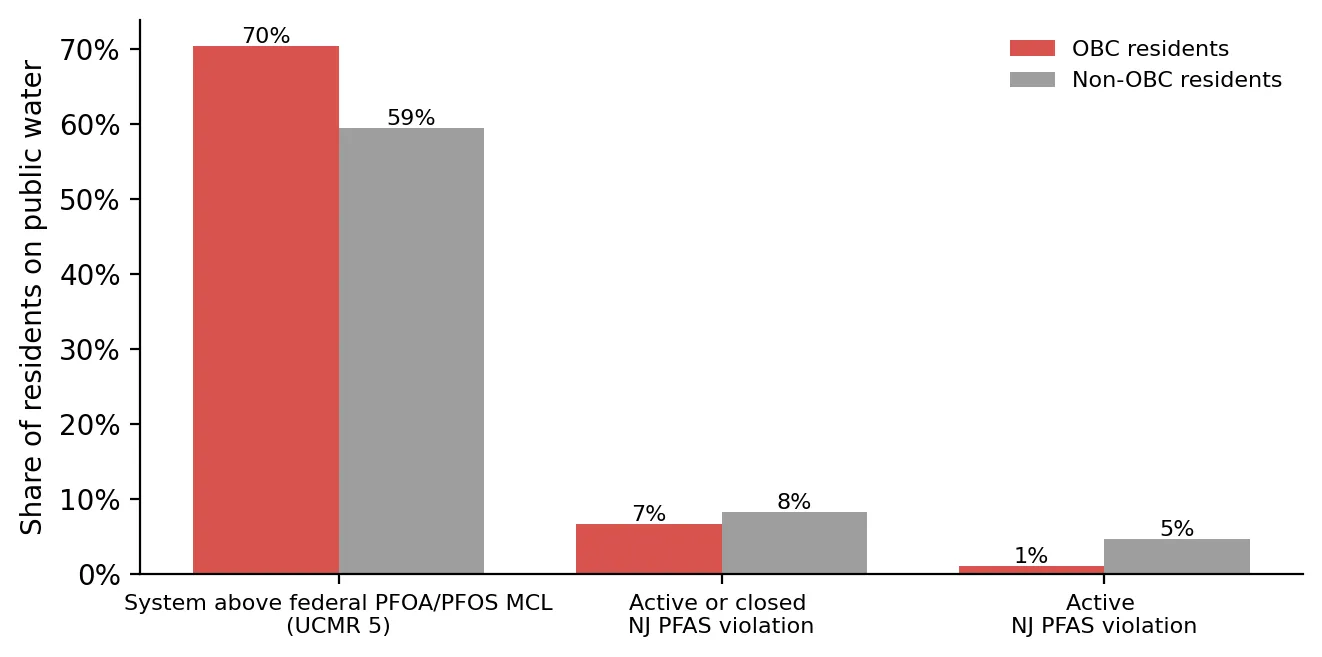 Figure 2. Share of residents on public water served by a system above the federal level, or with a New Jersey PFAS violation, by overburdened community status.
Residents of overburdened communities are somewhat more likely to be served by a system above the federal level (1.18 times), mainly because the large surface water systems serving Newark, Jersey City, Paterson, and Passaic County all exceed it. But the majority of all New Jerseyans on public water are in the same position. And the systems with active violations of the state’s stricter-era rules are mostly small suburban groundwater systems in Bergen and Essex counties, which serve relatively few overburdened communities.
The honest conclusion is that PFAS in New Jersey’s tap water is not primarily a story of unequal exposure. It reflects contamination of shared rivers and aquifers across a densely populated, heavily industrialized state.
5. Where the justice questions actually lie
The absence of a strong exposure gap does not mean PFAS raises no equity concerns. Three stand out.
1. Who pays. Treatment systems that remove PFAS, such as granular activated carbon, ion exchange, and reverse osmosis, are expensive to build and operate, and utilities usually recover the costs through water rates. A rate increase of the same dollar amount takes a larger share of a low-income household’s budget. Settlement money from 3M and DuPont can offset some costs, but only if it reaches the systems that need it. Whether those funds are distributed in proportion to need, or to which utilities apply first, is a policy choice with equity consequences.
2. Who isn’t tested. About 670,000 New Jersey residents live outside any community water system service area, most of them on private wells. UCMR 5 does not test private wells, and federal MCLs do not apply to them. Households must pay to test and treat their own water.
3. The regulatory rollback. If EPA rescinds the PFNA, PFHxS, and GenX limits and delays PFOA/PFOS compliance to 2031, New Jersey’s own standards become the main protection for those chemicals. New Jersey has maintained its PFNA limit, but states with weaker programs may not. Communities downstream of PFAS manufacturing, including in New Jersey’s Delaware River corridor, would bear the consequences of slower action.
6. Limitations
- Not formal compliance. My “highest entry-point mean” uses a few UCMR samples per entry point, not four consecutive quarters of compliance monitoring. Some systems have also installed treatment since sampling, which may have lowered their levels.
- Service areas and population. NJDEP service-area polygons overlap in a few places, and systems that buy water from other systems complicate assignments. Population counts from Census blocks (5.7 million in systems above the federal level) differ somewhat from EPA’s population-served figures (5.2 million).
- OBC status is a broad category. The comparison treats all overburdened communities alike. Specific low-income neighborhoods or private-well households could face higher burdens than these averages show.
7. Conclusion
New Jersey’s PFAS problem is large, statewide, and still unfolding. Under the federal standard, about six in ten residents on public water are served by a system that will need to reduce PFOA or PFOS. That exposure is broadly shared rather than concentrated in overburdened communities, which makes PFAS an unusual case in environmental justice research. The equity stakes lie in who pays for treatment, who is excluded from testing, and whether federal retreat leaves state limits as the last line of defense. Those questions are not settled by measuring concentrations alone.
Data and methods
The analysis was done in Python with public data. The full code, its data, and every figure it produces are in the code project below.
References
- Environment+Energy Leader. (2025, August). DuPont, Chemours settle NJ PFAS claims for $875M. https://environmentenergyleader.com/stories/dupont-chemours-settle-nj-pfas-claims-for-875m,86473
- Harvard Environmental & Energy Law Program. (2026). Regulatory tracker: PFAS in drinking water. https://eelp.law.harvard.edu/tracker/pfas-in-drinking-water/
- New Jersey Department of Environmental Protection. (2026). Community drinking water system PFAS violations in New Jersey [Data set]. https://services1.arcgis.com/QWdNfRs7lkPq4g4Q/arcgis/rest/services/NJDEP_Community_Drinking_Water_System_PFAS_Violations/FeatureServer
- ROI-NJ. (2025, May 14). State settlement with 3M over "forever chemicals" worth up to $450M. https://www.roi-nj.com/2025/05/14/industry/state-settlement-with-3m-over-forever-chemicals-worth-up-to-450m/
- The Sun. (2026, October 18). PFAS detected in 91% of 86 tested NJ waterways, Cooper River and Big Timber Creek among them. https://thesunpapers.com/2026/10/18/pfas-detected-in-91-of-86-tested-nj-waterways-cooper-river-and-big-timber-creek/
- U.S. Environmental Protection Agency. (2026). Fifth Unregulated Contaminant Monitoring Rule (UCMR 5) occurrence data [Data set, October 2026 release]. https://www.epa.gov/dwucmr/occurrence-data-unregulated-contaminant-monitoring-rule
- U.S. Environmental Protection Agency. (2026). Enforcement and Compliance History Online (ECHO): Safe Drinking Water Act systems, New Jersey [Data set].
- U.S. Geological Survey. (2026). [Study of PFAS in northern New Jersey drinking-water source rivers] (Scientific Investigations Report 2026-5018). https://pubs.usgs.gov/publication/sir20265018/full
- Waste Dive. (2026). EPA to formally rescind certain PFAS drinking water regulations. https://www.wastedive.com/news/epa-rescind-pfas-drinking-water-regulations-2026/820595/
- Zahm, S., Bonde, J. P., Chiu, W. A., et al. (2024). Carcinogenicity of perfluorooctanoic acid and perfluorooctanesulfonic acid. The Lancet Oncology, 25(1), 16–17. https://doi.org/10.1016/S1470-2045(23)00622-8